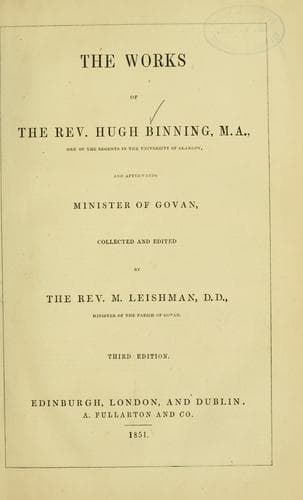
Presbyterian Church -- Sermons; Sermons, English; Theology -- Early works to 1800; Theology -- History -- 17th century
the body are at length overcome; and when life hath fled into a castle
within the city, the heart, that is, last of all, besieged so straitly,
and stormed so violently, that it must render unto death upon any terms.
The body of man is even a seminary of a world of diseases and grievances,
that if men could look upon it aright, they might see the sentence of
death every day performed. Then how many evils in estate, in friends and
relations, in employments, which being considered by heathens, hath made
them praise the dead more than the living, but him not yet born most of
all, because the present life is nothing else but a valley of misery and
tears, a sea of troubles, where one wave continually prevents another, and
comes on like Job’s messengers; before one speaks out his woful tidings,
another comes with such like, or worse. But that which is the sum and
accomplishment of God’s curse and man’s misery is that death to
come,—eternal death,—not death simply, but an “everlasting destruction
from the presence of the Lord and the glory of his power;”—an infinite
loss, because the loss of such a glorious life in the enjoyment of God’s
presence; and an infinite hurt and torment beside, and both eternal.
Now this is what we would lay before you. You are under such a heavy
sentence from the womb, a sentence of the Almighty, adjudging you for
Adam’s guilt and your own, to all the misery in this world and in the
next,—to all the treasures of wrath that are heaped up against the day of
wrath. And strange it is, how we can live in peace, and not be troubled in
mind, who have so great and formidable a party! Be persuaded, O be
persuaded, that there shall not one jot of this be removed,—it must be
fulfilled in you or your cautioner! And why then is a Saviour offered, a
city of refuge opened, and secure sinners will not flee into it? But as
for as many as have the inward dreadful apprehension of this wrath to
come, and know not what to do, know that to you is Jesus Christ preached,
the second Adam, a quickening spirit, and in that consideration, better
than the first,—not only a living soul himself, but a spirit to quicken
you who are dead in sins,—one who hath undertaken for you, and will hold
you fast. Adam, who should have kept us, lost himself; Christ in a manner
lost himself to save us. And as by Adam’s disobedience all this sin and
misery hath abounded on man, know, that the second Adam’s obedience and
righteousness are of greater virtue and efficacy to save and instead of
sin to restore righteousness, and instead of death to give life. Therefore
you may come to him, and you shall be more surely kept than before.
Lecture XXV.
Of The Way Of Man’s Delivery.
1 Tim. i. 15—“This is a faithful saying, and worthy of all
acceptation, that Christ Jesus came into the world to save
sinners.”
Public-domain text, read in full here on John Shaqi.
Reviews
Reviews
No reviews yet
Be the first to share your thoughts on this work.
Elsewhere in the archive
Join the Discussion
Join the discussion
Sign in to leave a comment or review.
Sign InorCreate an account