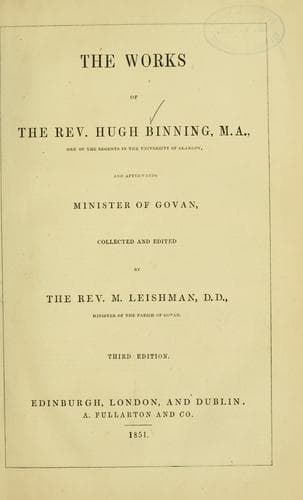
Presbyterian Church -- Sermons; Sermons, English; Theology -- Early works to 1800; Theology -- History -- 17th century
Rom. viii. 1.—“There is therefore now no condemnation to them
which are in Christ Jesus, who walk not after the flesh, but after
the Spirit.”
There are three things which concur to make man miserable,—sin,
condemnation, and affliction. Every one may observe that “man is born unto
trouble as the sparks fly upward,” that his days here are few and evil. He
possesses “months of vanity, and wearisome nights are appointed” for him.
Job v. 6, 7, vii. 3. He “is of few days and full of trouble,” Job xiv. 1.
Heathens have had many meditations of the misery of man’s life, and in
this have outstripped the most part of Christians. We recount amongst our
miseries, only some afflictions and troubles, as poverty, sickness,
reproach, banishment, and such like. They again have numbered even these
natural necessities of men amongst his miseries,—to be continually turned
about, in such a circle of eating, drinking, and sleeping. What burden
should it be to an immortal spirit to roll about perpetually that wheel!
We make more of the body than of the soul. They have accounted this body a
burden to the soul. They placed posterity, honour, pleasure, and such
things, which men pour out their souls upon, amongst the greatest miseries
of men, as vanity in themselves, and vexation, both in the enjoying and
losing of them, but, alas! they knew not the fountain of all this
misery,—sin and the accomplishment of this misery,—condemnation. They
thought trouble came out of the ground and dust, either by a natural
necessity, or by chance, but the word of God discovereth unto us the
ground of it, and the end of it. The ground and beginning of it was man’s
defection from God, and walking according to the flesh, and from this head
have all the calamities and streams of miseries in the world issued. It
hath not only redounded to men, but even to the whole creation, and
subjected it to vanity, ver. 20 of this chapter. Not only shall thou, O
man, (saith the Lord to Adam,) eat thy meat in sorrow, but thy curse is
upon the ground also, and thou who wast immortal, shalt return to that
dust which thou magnifiedst above thy soul, Gen. iii. 17. But the end of
it is suitable to the beginning. The beginning had all the evil of sin in
it, and the end hath all the evil of punishment in it. These streams of
this life’s misery, they run into an infinite, boundless, and bottomless
ocean of eternal wrath. If thou live according to the flesh, thou shalt
die, it is not only death here, but eternal death after this. The miseries
then of this present life are not a proportionable punishment of sin, they
are but an earnest given of that great sum which is to be paid in the day
of accounts, and that is condemnation, “everlasting destruction from the
presence of the Lord, and the glory of his power.” Now, as the law
discovers the perfect misery of mankind, so the gospel hath brought to
light a perfect remedy of all this misery. Jesus Christ was manifested to
Public-domain text, read in full here on John Shaqi.
Reviews
Reviews
No reviews yet
Be the first to share your thoughts on this work.
Elsewhere in the archive
Join the Discussion
Join the discussion
Sign in to leave a comment or review.
Sign InorCreate an account