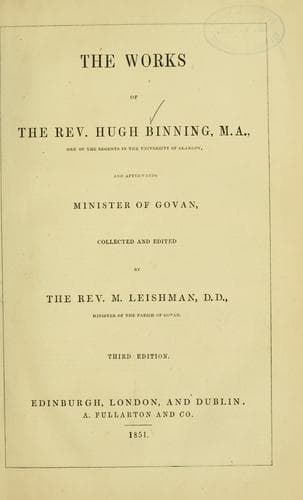
Presbyterian Church -- Sermons; Sermons, English; Theology -- Early works to 1800; Theology -- History -- 17th century
Now, since it is so, that such a condemnatory sentence is passed on all
men, what a privilege must it be, to be delivered from it,—to have that
sentence repealed by some new act of God’s mercy and favour? David
proclaims him a blessed man whose sins are forgiven and covered; and
indeed he is blessed who escapes that pit of eternal misery, though there
were no more. Though there were no title to an inheritance and kingdom
above, to be delivered from that wrath to come upon the children of
disobedience, this is more happiness than the enjoyment of all earthly
delights. “What shall a man give in exchange for his soul?” “Skin for
skin, yea, all that a man hath will he give for his life.” These riches
and advantages and pleasures that men spend their labour for, all these
they part with in such a hazard. The covetous man, he will cast his
coffers overboard ere he will lose his life; the voluptuous man, he will
suffer pain and torment in cutting off a member, ere he die. But if men
knew their souls, and what an immortality and eternity expects them, they
would not only give skin for skin, and all that they have, for their soul,
but their life also. Ye would choose to die a thousand deaths to escape
this eternal death. But “what shall a man give in exchange for his soul?”
Matt. xvi. 26; though he would give, yet what hath he to give? There are
two things endear any privilege to us, and heighten the rate of it,—the
necessity of it, and the preciousness of it; and these two are eminent
here. Is it not necessary to be, to live, and have a being? All men think
so, when they will give all they have to redeem themselves. All other
things are accidental to them, they are nearest to themselves; therefore
all must go, ere themselves go. But I say this is more necessary,—to be
well eternally, than to be simply; to escape this condemnation, than to
have a being. And this shall be verified in the last day, when men shall
cry for hills and mountains to fall on them, and save them from the wrath
of the Lamb, Rev. vi. 16. Men will choose rather not to be, than to fall
in that wrath. O how acceptable would a man’s first nothing be to him in
that great day of wrath! Who shall be able to stand in it?—when kings and
princes, bond and free, great and small, shall desire mountains to grind
them into powder, rather than to hear that sentence of condemnation, and
yet shall not obtain it. O blessed are all they that trust in him, “when
his wrath is kindled but a little,” Ps. ii. 12. Ye toil and vex
yourselves, and spend your time about that body and life; but for as
precious as they are to you now, ye would exchange them one day for
immunity and freedom from this wrath and curse. How will that man think
his lines are fallen in pleasant places,—how will he despise the glory of
earthly kingdoms, though all united in one,—who considers in his heart how
all kings, all tongues and nations, must stand before the judgment-seat of
Public-domain text, read in full here on John Shaqi.
Reviews
Reviews
No reviews yet
Be the first to share your thoughts on this work.
Elsewhere in the archive
Join the Discussion
Join the discussion
Sign in to leave a comment or review.
Sign InorCreate an account