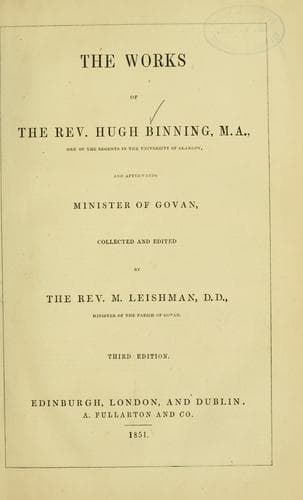
Presbyterian Church -- Sermons; Sermons, English; Theology -- Early works to 1800; Theology -- History -- 17th century
It is difficult to determine which of these is the greatest privilege of a
Christian,—that he is delivered from condemnation, or that he is made to
walk according to the Spirit, and made a new creature; whether we owe more
to Christ for our justification, or sanctification: for he is made both to
us: but it is more necessary to conjoin them together, than to compare
them with each other. The one is not more necessary—to be delivered from
wrath, than the other, to walk according to the Spirit. I think it were an
argument of a soul escaped from condemnation, to have the great stream and
current of its affections and endeavours towards sanctification, not that
they may be accepted of God, but because they are accepted of God. It is
not said, there is nothing condemnable in those that are in Christ, but
there is no condemnation to them. There is, indeed, a body of death, and
law of sin within them, a nature defiled with original pollution, and many
streams flowing from it, which the sprinkling of the blood of Christ in
justification doth not take away. If any man say there is no sin in him,
he is a liar, and the truth is not in him. But here is the grace and mercy
of God in Jesus Christ; that removes the curse where the sin is,—that
takes away the condemnation where all worthy of condemnation is. And thus
the soul’s justification is parallel to Christ’s condemnation. There was
in him nothing condemnable, no sin, no guile in his mouth; yet there was
condemnation to him, because he was in stead and place of sinners. Our
iniquities were laid on him, not in him; he who knew no sin was made a
curse for us, that we might be made the righteousness of God in him. So
then, the soul that fleeth into Jesus Christ’s righteousness, though it
have in it all that deserveth condemnation, yet there is no condemnation
to it, because his righteousness is laid upon it, and Christ hath taken
away the curse. The innocent Son of God was condemned, therefore are
guilty sinners absolved. The curse was applied unto him who had no sin,
but only was made sin, or sin laid on him, and therefore the sentence of
absolution from the curse is applied unto them who have no righteousness,
but are made the righteousness of God by free and gracious imputation.
This I speak, because of many unsavoury and unsound expressions in this
loose generation, that there is no sin in the justified, that
justification removes it close, as if it had never been at all. I say, as
the condemnation of Jesus Christ did not blot out his innocency and
holiness within him, but only justice considered him on that account as a
transgressor, who yet was the holy and spotless Lamb of God in himself; so
likewise the justification of a sinner before God, doth not remove or blot
out the very corruption and defilement of our natures, but only scrapes
out our names out of the roll of his debtors, as having satisfied in our
cautioner, and considers us as righteous on that account before God. And
Public-domain text, read in full here on John Shaqi.
Reviews
Reviews
No reviews yet
Be the first to share your thoughts on this work.
Elsewhere in the archive
Join the Discussion
Join the discussion
Sign in to leave a comment or review.
Sign InorCreate an account