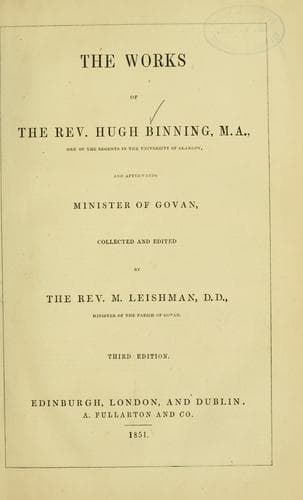
Presbyterian Church -- Sermons; Sermons, English; Theology -- Early works to 1800; Theology -- History -- 17th century
I find that Antinomians(161) confound this question, that they may have
the more advantage in their darkness. The question is not concerning the
grounds of a man’s believing in Christ, but concerning our assurance, or
knowledge of our believing. There is a great mistake in Christians
practice, in confounding these two. It makes Christians very unreasonable
in their doubtings and exercises; therefore let us have this before our
eyes,—faith, in its first and pure acting, is rather an adherence and
cleaving of a lost soul to Christ, than an evidence of its interest in
him, or of his everlasting love. You know all, that it is one thing to
know a thing, or love a thing, and another thing to reflect upon it, and
know that I know and love it. John did write to believers, that they might
know they did believe, and believe yet more. These things then are both
separable, and the one is posterior to the other,—“after that ye believed
ye were sealed.” The persuasion of God’s love and our interest in Christ,
is the Spirit’s seal set upon the soul. There is a mutual sealing here.
The soul, by believing and trusting in Jesus Christ, “sets to its seal
that God is true,” as John speaks, John iii. 33. When God speaks in his
law, the soul receives that testimony of his justice and holiness,
subscribes to the equity and righteousness of the sentence, by condemning
itself. And when Christ speaks in the gospel, the soul seals that doctrine
of free salvation, by approving and consenting with all its heart to the
offer, subscribes to the way of salvation in Christ, and the truth of his
promises. And thus is the truth of God and Christ sealed, by the soul’s
believing. Then the Spirit of Jesus Christ afterward, when he pleaseth,
irradiates and shines upon the soul, and discovers those things that are
freely given, and witnesseth to the conscience of the believer, that he is
a son of God. Thus the Spirit seals the believer, and gives his testimony
to his truth.(162)
Public-domain text, read in full here on John Shaqi.
Reviews
Reviews
No reviews yet
Be the first to share your thoughts on this work.
Elsewhere in the archive
Join the Discussion
Join the discussion
Sign in to leave a comment or review.
Sign InorCreate an account