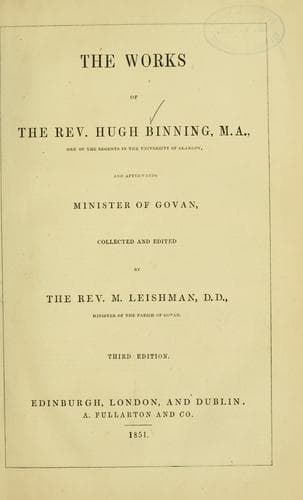
Presbyterian Church -- Sermons; Sermons, English; Theology -- Early works to 1800; Theology -- History -- 17th century
Binning was the author of it. And lastly, Mr. Binning was of a pacific
temper, and his sentiments with respect to public differences were
healing, which are evident from the accounts already given of his printed
books. And to show that he was a promoter of brotherly love, and of the
peace of the church, I shall set down a few passages taken from his
Treatise of Christian Love, which are as bright and strong for
recommending the same, as any that I have met with in the writings of any
of our divines, so that I can’t allow myself to think he could be the
author thereof. In chapter 2d of that Treatise, he says, “There is a
greater moment and weight of Christianity in charity, than in the most
part of those things for which Christians bite and devour one another. It
is the fundamental law of the gospel, to which all positive precepts and
ordinances should stoop. Unity in judgment is very needful for the well
being of Christians. But Christ’s last words persuade this, that unity in
affection is more essential and fundamental. This is the badge he left to
his disciples. If we cast away this upon every different apprehension of
mind, we disown our Master, and disclaim his token and badge.”(130) He
goes on in the same strain in the following paragraph—“The apostle Paul
puts a high note of commendation upon charity, when he styles it the bond
of perfection. ‘Above all things (says he) put on charity, which is the
bond of perfectness,’ Col. iii. 14. I am sure it hath not so high a place
in the minds and practice of Christians now, as it hath in the roll of the
parts and members of the new man here set down. Here it is above all. With
us it is below all, even below every apprehension of doubtful truths. An
agreement in the conception of any poor petty controversial matter of the
times, is made the badge of Christianity, and set in an eminent place
above all.”(131) And in the same chapter he adds, “This is the sum of all,
to worship God in faith and purity, and to love one another. And,
whatsoever debates and questions tend to the breach of this bond, and have
no eminent and remarkable advantage in them, suppose they be conceived to
be about matters of conscience, yet the entertaining and prosecuting of
them to the prejudice of this, is a manifest violence offered to the law
of God, which is the rule of conscience. It is a perverting of scripture
and conscience to a wrong end. I say then, that charity and Christian love
should be the moderatrix of all our actions towards men. From thence they
should proceed, and according to this rule be formed. I am persuaded if
this rule were followed, the present differences in judgment of godly men,
about such matters as minister mere questions, would soon be buried in the
gulf of Christian affection.”(132) I shall mention only another in the
same chapter. “Is not charity more excellent than the knowledge and
acknowledgment of some present questionable matters about government,
Public-domain text, read in full here on John Shaqi.
Reviews
Reviews
No reviews yet
Be the first to share your thoughts on this work.
Elsewhere in the archive
Join the Discussion
Join the discussion
Sign in to leave a comment or review.
Sign InorCreate an account