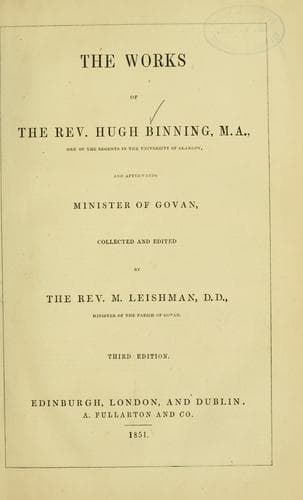
Presbyterian Church -- Sermons; Sermons, English; Theology -- Early works to 1800; Theology -- History -- 17th century
its own being. Shall the thing formed say to the potter, Thou hast not
made me? That were ridiculous. And shall the thing formed say, ’Tis made
for itself? That were as ridiculous. Self-denial is the ornament and
beauty of a creature, and therefore humility is an ornament and clothing,
1 Pet. v. 5; and honour upholds the humble spirit, Prov. xxix. 23. But
God’s self-seeking, and seeking of his own glory, is his eminent
excellency. It is indeed his glory, because he is, and there is none else;
there is nothing, besides him, but that which hath issued forth from his
incomprehensible fulness. And therefore it is all the reason of the world,
that as he is the beginning, so he should be the end of all things, Rev.
i. 8. And there is the more reason of it, that his majesty’s seeking of
his own glory is not prejudicial to the creature’s good, but the very
communication of his fulness goes along with it: so that in glorifying
himself, he is most beneficial to his own creatures. Poor creatures,
indigent at home, are yet proud of nothing, and endeavour, in seeking of
themselves, to engross all perfections into their own bosoms! Ambition and
vainglory robs and spoils others’ excellencies to clothe itself withal;
and then boasts itself in these borrowed feathers! But our blessed Lord is
then doing most for our advantage when he does all for his own glory. He
needs not go abroad to seek perfection, but to manifest what he is in
himself; he communicates of himself to us. O blessed self-seeking that
gave us a being and well-being; that makes no advantage by it, but gives
advantage! He hath the honour of all, but we have the profit of all.
Public-domain text, read in full here on John Shaqi.
Reviews
Reviews
No reviews yet
Be the first to share your thoughts on this work.
Elsewhere in the archive
Join the Discussion
Join the discussion
Sign in to leave a comment or review.
Sign InorCreate an account