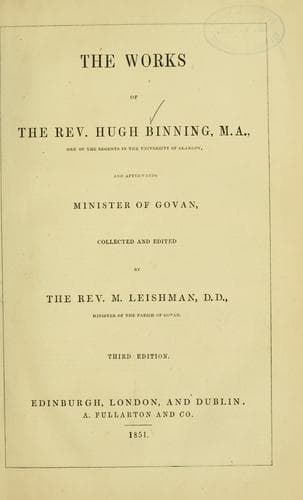
Presbyterian Church -- Sermons; Sermons, English; Theology -- Early works to 1800; Theology -- History -- 17th century
swaddling clothes of the scriptures, and this poor cottage the child
Jesus, the Lord of heaven and earth, is contained. There is a jewel of the
mysterious wisdom of God, and man’s eternal blessedness, in this mineral.
What glorious and astonishing humility is here! What humble and homely
glory and majesty also! He is most high, and yet none so lowly. What
excellent consent and harmony of many writers in such distant times!
Wonder at it. All speak one thing to one purpose,—to bring men to God, to
abase all glory, and exalt him alone. Must it not be one spirit that hath
quickened all these and breathes in them all this one heavenly song of
“glory to God on high and good will towards men.” Other writers will
reason these things with you to convince you and persuade you, and many
think them more profound and deep for that reason, and do despise the
baseness of the scriptures, but to them whose eyes are opened, the majesty
and authority of God commanding and asserting and testifying to them, is
more convincing from its own bare assertion, than all human reason.
Although there be much light in the scriptures to guide men’s way to God’s
glory and their own happiness, yet it will all be to small purpose if “the
eyes of our understanding be darkened and blinded.” If you shall surround
a man with day light, except he open his eyes he cannot see. The
scriptures are a clear sun of life and righteousness, but the blind soul
encompassed with that light is nothing the wiser, but thinks the lamp of
the word shines not, because it sees not, it hath its own dungeon within
it. Therefore the Spirit of God must open the eyes of the blind, and
enlighten the eyes of the understanding, that the soul may see wonderful
things in God’s law, Psal. cxix. 5, 18. The light may shine in the
darkness, but “the darkness comprehendeth it not,” John i. 5. I wonder not
that the most part of men can see no beauty, no majesty, no excellency in
the holy scriptures to allure them, because they are natural, and have not
the Spirit of God, and so cannot know these things “for they are
spiritually discerned,” 1 Cor. ii. 14. Therefore as the inspiration of God
did conceive this writing at first, and preached this doctrine unto the
world, so there can no soul understand it, or profit by it, but by the
inspiration of the Almighty. “Verily there is a spirit in man, and the
inspiration of the Almighty giveth him understanding,” saith Job. When the
Spirit comes into the soul to engrave the characters of that law and truth
into the heart which were once engraven on tables of stone, and not
written with pen and ink, then the Spirit of Christ Jesus writes over and
transcribes the doctrine of the gospel on “the fleshly tables of the
heart,”—draws the lineaments of that faith and love preached in the word
upon the soul, then the soul is “the epistle of Christ,” “written not with
[pen and] ink, but with the Spirit of the living God,” 2 Cor. iii. 3. And
Public-domain text, read in full here on John Shaqi.
Reviews
Reviews
No reviews yet
Be the first to share your thoughts on this work.
Elsewhere in the archive
Join the Discussion
Join the discussion
Sign in to leave a comment or review.
Sign InorCreate an account