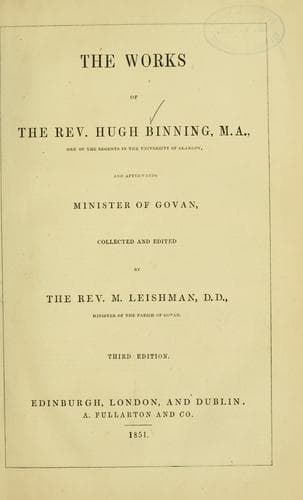
Presbyterian Church -- Sermons; Sermons, English; Theology -- Early works to 1800; Theology -- History -- 17th century
such are many of you, and yet you would not take well to have it
questioned whether ye shall be partakers of eternal life. You think you
are wronged when that is called in question. Oh that it were beyond all
question indeed! But know assuredly that you are but Christians in the
letter,—in the flesh and not in the spirit. Many of you have not so much
as “a form of knowledge”—have not so much as the letter of religion. You
have heard some names in the preaching often repeated,—as Christ, and God,
and faith, and heaven, and hell,—and you know no more of these but the
name. You consider not and meditate not on them, and though you know the
truth of the word, yet the word abideth not nor dwelleth in you. You have
it in your mouth, you have it in your mind or understanding, but it is not
received in love, it doth not dwell in the heart. “Let the word of Christ
dwell in you richly,” Col. iii. 16. You have it imprisoned in your minds,
and shut up in a corner where it is useless, and can do no more but
witness against you, and scarce that. As the Gentiles incarcerated and
detained the truth of God, written by nature within them, in
unrighteousness, (Rom. i. 18) so do many of you detain the knowledge of
his word in unrighteousness. It hath no place in the heart, gets no
liberty and freedom to walk through the affections and so to order the
conversation of men, and therefore the most part of men do but fancy to
themselves an interest and right to eternal life. You think it, and do but
think it, it is but a strong imagination, that hath no strength from the
grounds of it, no stability from any evidence or promise, but merely from
itself, or it is but a light and vain conjecture that hath no strength in
it because there is no question or doubts admitted which may try the
strength of it. But then I suppose that a man could attain some answerable
walking, that he had not only a form of knowledge, but some reality of
practice, some inward heat of affection and zeal for God and godliness,
yet there is one thing that he wants, and if it be wanting will spoil all,
and it is this, which Christ reproves in the Jews, “you will not come to
me to have life, the scriptures testify of me, but you receive not their
testimony.” Suppose a man had as much equity and justice towards men,
piety towards God, and sobriety towards himself, as can be found amongst
the best of men, let him be a diligent reader of the scriptures, let him
love them, and meditate on them day and night, yet if he do not come out
of himself, and leave all his own righteousness as dung behind him, that
he may be found in Jesus Christ, he hath no life, he cannot have any right
to the eternal. You may think this is a strange assertion, that if a man
had the righteousness and holiness of an angel, yet he could not be saved
without denying all that, and fleeing to Christ as an ungodly man, and you
may think it as strange a supposal, that any person that reads the
Public-domain text, read in full here on John Shaqi.
Reviews
Reviews
No reviews yet
Be the first to share your thoughts on this work.
Elsewhere in the archive
Join the Discussion
Join the discussion
Sign in to leave a comment or review.
Sign InorCreate an account