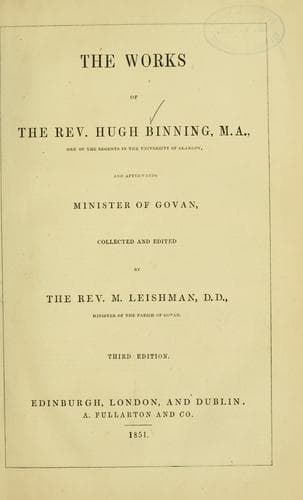
Presbyterian Church -- Sermons; Sermons, English; Theology -- Early works to 1800; Theology -- History -- 17th century
Look then what is in the Holy Scriptures, and you shall find it but a
letter of death and ministration of condemnation while it is separated
from him. Christ is the very life and spirit of the scriptures by whose
virtue they quicken our souls. If you consider the perfect rule of
righteousness in the law, you cannot find life there, because you cannot
be conformed unto it, the holiest man offends in every thing, and that
holy law being violated in any thing will send thee to hell with a cure.
“Cursed is he that abideth not in all things.” If you look upon the
promise of life, “do this and live,” what comfort can you find in it,
except you could find doing in yourselves? And can any man living find
such exact obedience as the law requires? There is a mistake among many.
They conceive that the Lord cannot but be well pleased with them if they
do what they can. But be not deceived,—the law of God requires perfect
doing, it will not compound with thee and come down in its terms, not one
jot of the rigour of it will be remitted. If you cannot do all that is
commanded, all you do will not satisfy that promise, therefore thou must
be turned over from the promise of life to the curse, and there thou shalt
find thy name written. Therefore it is absolutely necessary that Jesus
Christ be made under the law, and give obedience in all things, even to
the death of the cross, and so be made a curse for us, and sin for us,
even he “who knew no sin.” And thus in him you find the law fulfilled,
justice satisfied, and God pleased. In him you find the promise of life
indeed established in a better and surer way than was first propounded.
You find life by his death, you find life in his doing for you. And again,
consider the ceremonial law,—what were all those sacrifices and
ceremonies? Did God delight in them? Could he savour their incense and
sweet smells, and eat the fat of lambs and be pacified? No, he detects and
abhors such abominations! Because that people did stay in the letter, and
went no further than the ceremony, he declares that it was as great
abomination to him as the offering up of a dog. While they were separated
from Jesus Christ, in whom his soul rested and was pacified, they were not
expiations, but provocations; they were not propitiations for sin, but
abominations in themselves. But take these as the shadow of such a living
substance; take them as remembrances of him who was to come, and behold
Jesus Christ lying in these swaddling clothes of ceremonies, until the
fulness of time should come, that he might be manifested in the flesh, and
so you shall find eternal life in those dead beasts, in those dumb
ceremonies. If you consider this Lamb of God slain in all these
sacrifices, from the beginning of the world, then you present a sweet
smelling savour to God,—then you offer the true propitiation for the sins
of the world,—then he will delight more in that sacrifice than all other
personal obedience.
Public-domain text, read in full here on John Shaqi.
Reviews
Reviews
No reviews yet
Be the first to share your thoughts on this work.
Elsewhere in the archive
Join the Discussion
Join the discussion
Sign in to leave a comment or review.
Sign InorCreate an account