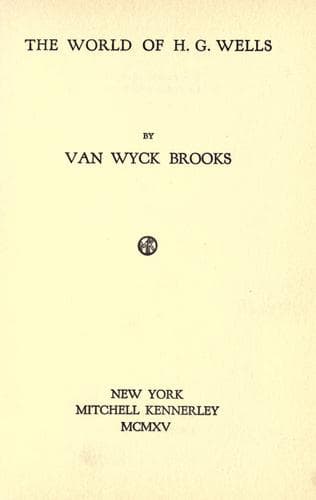
Science fiction, English -- History and criticism; Wells, H. G. (Herbert George), 1866-1946 -- Criticism and interpretation
This candid and exact statement enables us to see just how far, in
matters of fact, experience and belief, the autobiographical motive has
entered his writings. It would be possible to show how inevitably such
an ideal as that of the New Republican Samurai arose from such a life;
how much that conscious and deliberate insistence on personal efficiency
and orderly ways, that repudiation of mental confusion, sluggishness,
and sentiment may figure as a kind of stepping-stone from the world of
Kipps and Polly to the world of Remington and Trafford; how a
self-wrought scientific education would form the basis of an ideal of
aristocracy rising from it; and how the motto "There is no Being but
Becoming" would express its own constant desertion of levels achieved,
its own pressing upward to levels equally transient. Just as the
"democratic person" of Whitman raises his own fervent, chaotic, and
standardless experience into an ideal, so also the ideal of Wells is
nothing else than the projection of his own experimental opportunism. It
is impossible in discussing Wells to ignore this social ascent; for in
England a man passes from one stratum to another only by virtue of a
certain lack of substantiality, a power to disencumber himself, to shed
customs and affections and all the densenesses and coagulations which
mark each grade in that closely defined social hierarchy. The world of
shopkeeping in England is a world girt about with immemorial
subjections; it is, one might say, a moss-covered world; and to shake
oneself loose from it is to become a rolling stone, a drifting and
unsettled, a detached and acutely personal, individual. It is to pass
from a certain confined social maturity, a confused mellowness, into a
world wholly adventurous and critical, into a freedom which achieves
itself at the expense of solidity and warmth. In Wells, for instance,
the sense of the soil is wholly supplanted by the sense of machinery.
His evolution has been the reverse of the usual evolution from what
Bacon called the _lumen siccum_ to the _lumen humidum_, from the dry
light to the light that is drenched in customs and affections. Instead
of growing mellower, he has grown more and more fluid and electric, in
direct ratio to the growing width of his social horizon.
Public-domain text, read in full here on John Shaqi.
Reviews
Reviews
No reviews yet
Be the first to share your thoughts on this work.
Elsewhere in the archive
Join the Discussion
Join the discussion
Sign in to leave a comment or review.
Sign InorCreate an account