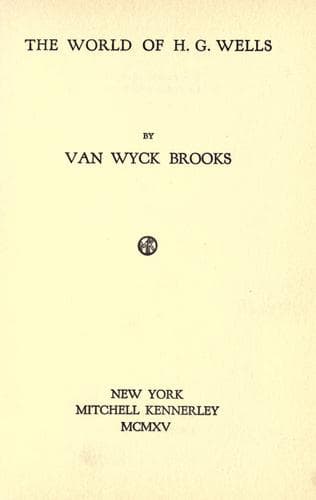
Science fiction, English -- History and criticism; Wells, H. G. (Herbert George), 1866-1946 -- Criticism and interpretation
To prove this one has only to consider his novels. There was a time when
he had in common with Dickens and De Foe the quality they have in common
with one another--the quality of homeliness. He drew the little world he
knew well, the limited and lovable world of small folk. Mr. Hoopdriver,
Delia the chambermaid, Kipps and Ann Pornick--a score of these helpless,
grown-up little children he pictured with a radiant affection, tempering
the wind to the shorn lamb. It is more in the nature of his later
thought to see poverty as a wasteful rather than a cruel thing, even
though he may not have approached the harsh realism of Bernard Shaw's
observation: "I have never had any feeling about the English working
classes except a desire to abolish them and replace them by sensible
people."
Certainly he has not experienced any other world in quite this way. "I
count that wide social range one of the most fortunate accidents in my
life," he says. Accidental one feels it to be, as of a man inhabiting
the great world by virtue of sheer talent, whose nature has not in any
sense settled there. His philosophy and his socialism are outgrowths of
his own experience; they erect into reasons and theories the nature of a
life which is not at home, and which easily unburdens itself of all that
seems insensate because it is unfamiliar. To be a socialist at all is to
have accustomed oneself, through necessity or imagination, to a certain
detachment from a great many of the familiar, lovable, encumbering,
delightful stupidities of the world. And Wells has travelled up and down
through time and space too much to have any great regard for the
present. "I have come to be, I am afraid," he says, in _The Future in
America,_ "even a little insensitive to fine immediate things through
this anticipatory habit.... There are times indeed when it makes life
seem so transparent and flimsy, seem so dissolving, so passing on to an
equally transitory series of consequences----." His hold upon the
present is so far from inevitable that _The New Machiavelli_ and
_Marriage_, realistic as they are, are represented as being written some
years hence, our own time already appearing retrospectively in them. As
little as Faust has he been tempted to call out upon the passing moment.
His main characters drift through this period of time, substantial
themselves but with a background of substantialities, in a way that
recalls Paolo and Francesca looming out of the phantom cloud-procession
of the _Inferno_.
Public-domain text, read in full here on John Shaqi.
Reviews
Reviews
No reviews yet
Be the first to share your thoughts on this work.
Elsewhere in the archive
Join the Discussion
Join the discussion
Sign in to leave a comment or review.
Sign InorCreate an account