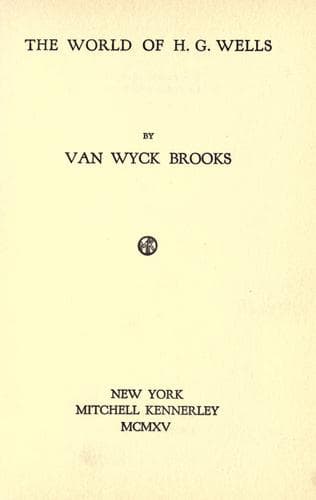
Science fiction, English -- History and criticism; Wells, H. G. (Herbert George), 1866-1946 -- Criticism and interpretation
The truth is that Wells, for all that he has passed outside the
economics of socialism, is really bounded by the circle of ideas which
produced them. The typical Marxian, the concentrated Marxian, will tell
you that life is summed up in the theory of value, and that the only
true thing is economic determinism. Measuring all thought by that
criterion, he finds Dante and Shakespeare unintelligible and offensive
gibberish, and will scent the trail of the capitalist in Grimm's Fairy
Tales. That is the crude form in which exclusive socialism presents
itself. To say that "the fundamental nature of life is a tissue and
succession of births" is merely a refinement of this. It is true, just
as the economic determinism of Marx on the whole is true. But the world
is full of a number of things; or rather it is the business of a
reasonable mind to see it in a number of ways at once. Because there is
a Will to Live and a Will to Power, because things grow and continue to
grow, that does not explain love, or pain, or friendship, or music, or
poetry, or indeed life. Life is a tangle, a tangle which every socialist
must feel to be disentangling itself; but it is also a riddle, and on
that point socialism has nothing to say at all.
It is in presenting life wholly as a tangle and not at all as a riddle
that the philosophy and religion of Wells appear so inadequate. Could
Wells write a poem? one asks oneself, and the question is full of
meaning. There is nothing to suggest that at any moment of his life he
has felt this impulse, which has been the normal thing in English
authors. "Modern poetry, with an exception or so," he remarks somewhere,
and for all his writings reveal of him he might have said poetry as a
whole, "does not signify at all." It is the same with regard to music,
art, external nature. He is not wanting in the plastic sense: his
writings are filled with picturesque groupings, figures cut in outline
against a sunset, masses of machinery in the glare of the forge, things
that suggest the etcher's eye. But they are curiously impersonal.
Consider, for example, his description of Worms Cathedral:
It rises over this green and flowery peace, a towering,
lithe, light brown, sunlit, easy thing, as unconsciously and
irrelevantly splendid as a tall ship in the evening glow
under a press of canvas.
You cannot doubt that he has felt a beauty in this, but the beauty he
feels is essentially the beauty of a piece of engineering; he is as
untouched by the strictly personal artistic and religious qualities of
this building, not to mention its connection with human history, as if
he had seen it through a telescope from another planet. It is not the
changeless riddle and partial solution of life for which this building
stands that stir in Wells the sense of beauty and meaning: it is the
mechanism, the process--his emotions gather about the physical result
which appears to justify these.
_À chacun son infini_.
Public-domain text, read in full here on John Shaqi.
Reviews
Reviews
No reviews yet
Be the first to share your thoughts on this work.
Elsewhere in the archive
Join the Discussion
Join the discussion
Sign in to leave a comment or review.
Sign InorCreate an account