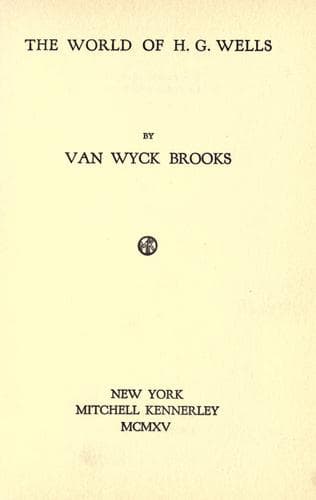
Science fiction, English -- History and criticism; Wells, H. G. (Herbert George), 1866-1946 -- Criticism and interpretation
Merely to dismiss as dumb folly an all but universal contention of this
kind (no doubt in the back of people's minds when they say that
socialism, for instance, is "against human nature") is to beg the whole
question of intellectualism itself. For, if it could be conclusively
shown that any view of life not incidentally but by its nature
emasculated life and destroyed the roots of character, then of course,
no matter how rationally self-evident it might be and how much confusion
and suffering it might avert, it would never even justify its own reason
for being--it would never _succeed,_ the best part of human nature would
oppose it to the end of time and the intelligence itself would be
discredited. And indeed to the man of experience rather than the man of
ideas, just because of his rich humanity, just because he never passes
out of the personal range, belong the ideal things, morality,
philosophy, art. Like charity, these things "begin at home"; and
whenever (as in pragmatism, when pragmatism ceases to be a method and
claims to be an interpretation of life) they are approached not from the
side of experience but from the side of ideas they cease to have any
real substance. Morality has no substance when it springs from the mind
instead of the conscience, art when it appeals to the mind instead of
the perceptions; and as to philosophy, what is any scheme of things that
springs out of the head of a man who is not himself wise? It is a
certain condemnation of Bergson, for example, that he would never pass
muster in a group of old fishermen smoking their pipes on the end of a
pier. Not that they would be expected in any case to know what he was
talking about, but that his fibre so plainly is the fibre not of a wise
but of a clever man and that in everything, as Emerson said, you must
have a source higher than your tap.
That is why, as it seems to me, Wells ought not to be considered from
any of these absolute standpoints. He has put before us not so much a
well-wrought body of artistic work, or a moral programme, or an
explanation of life--words quite out of place in connection with
him--as a certain new spirit, filled with all sorts of puzzled
intimations of a new beauty and even a new religion to be generated out
of a new order of things that is only glimpsed at present. And the point
I should like to make about this spirit is that it is entirely
irrelevant to the values of life as we know them, but that it may in the
end prove to have contributed to an altogether fresh basis for human
values.
Public-domain text, read in full here on John Shaqi.
Reviews
Reviews
No reviews yet
Be the first to share your thoughts on this work.
Elsewhere in the archive
Join the Discussion
Join the discussion
Sign in to leave a comment or review.
Sign InorCreate an account