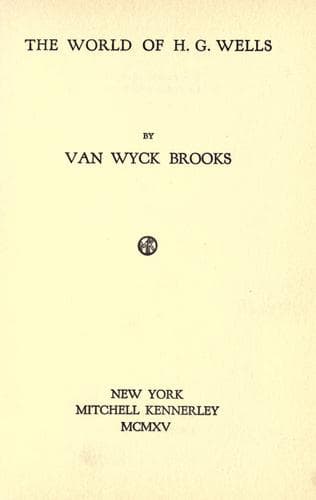
Science fiction, English -- History and criticism; Wells, H. G. (Herbert George), 1866-1946 -- Criticism and interpretation
That has been the office of socialism, and just so far as that proof has
been established socialism has played its part. Now the point I want to
make about Wells is that in him one sees already in an almost precocious
form the second stage of this process. In him this new world of
intelligence is already exuberant with instinct; the social machine has
become a personality; that cold abstraction the world has become in his
hands a throbbing, breathing, living thing, as alive, awake, aware of
itself, as engaging, adventurous, free, critical, well-primed,
continent, and all-of-a-piece as a strong man running a race. People
never felt nature as a personality before Wordsworth showed them that it
was, or a locomotive before Kipling wrote _McAndrew's Hymn_; and it
seems to me that Wells has done for the social organism very much what
Wordsworth did for nature, discovering in a thing previously felt to be
inanimate a matter for art and a basis for religious emotion.
But if the world is a personality it is a very stupid, sluggish,
unawakened personality, differing from nature in this respect, that we
ourselves compose the whole of it and have it in our hands to do what we
will with it. It has always been out of joint, a great slipshod
Leviathan, at sixes and sevens, invertebrate and fungus-brained. Just so
is the average man, sunk in routine, oppressed with microscopic tasks
that give birth one to another, his stomach at war with his head, his
legs unwilling to exercise him, resentful of his own capacity not to be
dull. But certain happier moments bring him an exuberant quickened life
in which routine tasks fall nimbly from his fingers and he is aware of a
wide, humorous, generous, enlightened vision of things; he pulls himself
together, his parts reinforce one another, his mind wakens, his heart
opens, his fancy stirs, he is all generosity and happiness, capable of
anything that is disinterested, fine, and becoming to a free man. It is
in these moments that individual men have done all the things which make
up the real history of this planet.
Public-domain text, read in full here on John Shaqi.
Reviews
Reviews
No reviews yet
Be the first to share your thoughts on this work.
Elsewhere in the archive
Join the Discussion
Join the discussion
Sign in to leave a comment or review.
Sign InorCreate an account