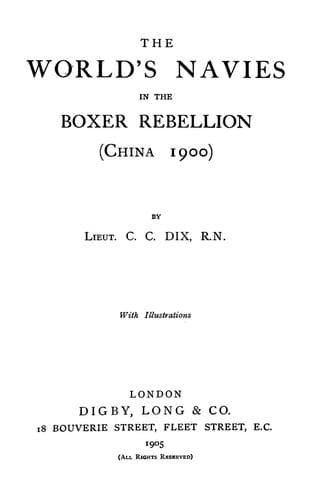
The world's navies in the Boxer rebellion (China 1900)Dix, Charles Cabry
History
The world's navies in the Boxer rebellion (China 1900)
Dix, Charles Cabry
China -- History -- Boxer Rebellion, 1899-1901
The attack on the French position was more deadly and more
successful. In the early forenoon two muffled crashes were heard in
the direction of the Minister’s house, and it speedily became known
that the house, together with that of the Secretary of Legation,
had been entirely destroyed by the well-timed explosion of two
mines. This caused the French also to fall back on the next inner
line of defence with some loss. It was, however, ascertained that
the Chinese sappers blew considerably more of their precious selves
to glory than the number of Frenchmen they killed, which was only
two. Notwithstanding this fact, the Chinese seemed very elated at
the result of their labours, and taking encouragement from the noise
and smoke, attacked a position to the left of the one where they had
suffered their reverse at the hands of the Germans and Russians.
Here they were met by a strong post of Americans, who were, most
inopportunely for the enemy, just changing guard, and who quickly
sent them to the rightabout.
On the whole, the day had been disastrous for the defenders, who had
lost ground at two points, and whose numbers had been decreased by
fourteen (five killed and nine wounded). The Chinese, however, did
not get off scatheless, and it is probable that their casualties
mounted up to at least 150 from all causes.
The 14th and 15th passed comparatively quietly, after this fierce
attack, but the noise of pick and shovel betrayed the enemy’s
intentions of springing some more mines upon the defenders, and
steps were taken to foil this measure by countermining. This work
was done by Chinese converts, under the guidance of a volunteer from
the I. M. Customs. It was now arranged that the Japanese in the Fu
should be relieved for some hours’ sleep by our Marines, and that the
transfer should take place early next morning. This transfer must
not be confounded with the slight alterations in the scheme of the
defence of the Fu before mentioned. But this necessary arrangement
cost the life of Captain Strouts, R.M.L.I., the commanding officer of
the British guard; for whilst returning from posting the relieving
sentries, he was fatally wounded in the groin, and died within three
hours. This was a very serious loss to the defence, as this officer
had been of the greatest service and had repeatedly distinguished
himself by his fearless behaviour. His death might be termed very
hard luck, as it was on this day that the extraordinary truce began,
which lasted for four days. It is rather difficult to assign any
good reason for the almost total cessation of hostilities on the
part of the Chinese, who indeed appeared to be almost embarrassingly
friendly for a day or two; but suffice to say it enabled the garrison
to repair their shattered defences and to take further precautions
against mines.
Public-domain text, read in full here on John Shaqi.
Reviews
Reviews
No reviews yet
Be the first to share your thoughts on this work.
Elsewhere in the archive
Join the Discussion
Join the discussion
Sign in to leave a comment or review.
Sign InorCreate an account