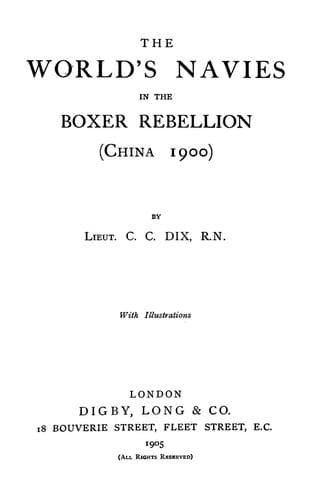
The world's navies in the Boxer rebellion (China 1900)Dix, Charles Cabry
History
The world's navies in the Boxer rebellion (China 1900)
Dix, Charles Cabry
China -- History -- Boxer Rebellion, 1899-1901
BRITISH.—At first sight it may seem unnecessary to touch upon either
the equipment or the internal economy of any British Force; but it
is an unpleasant fact that but few Englishmen really know what a
bluejacket looks like even on board his ship, and still fewer have
any idea of his organisation when “clearing up decks” ashore in the
out-of-the-way parts of the world, in which his services as a soldier
are more often required than is commonly supposed. Thus the matter
becomes of interest; and as the looks and methods of the soldiers,
both British and Indian, are more easily read about, and therefore
more widely known, it is only proposed to treat of the Naval Brigade
and the Chinese regiment, which latter was at the time the growth
of little more than a year. The organisation of a body of seamen
working ashore is much as follows: A battleship, on receiving orders
to land every available man for service like the one we are dealing
with, would probably have the following numbers told off: Marines 80
to 100, four companies of bluejackets consisting of one lieutenant,
two midshipmen, with fifty petty officers and men each. Two Maxim
guns, crews consisting of two officers and twelve men each; two
field guns, crews consisting of eighteen men and two officers each.
In addition to these there would be officer commanding and staff,
officer commanding marines and staff, one doctor, two sick-berth
attendants with medical necessities, four or five signalmen,
buglers, blacksmiths, armourers, carpenters, cook’s mate, an officer
of the accountant branch, and two or three subordinates, one ship’s
corporal, and a strong stretcher party of stokers under an engineer
officer. Thus it will be seen that each battleship can with ease
land 450 men, and is turned out as a complete unit, the men being
under their own officers, and self contained in every detail. A
bluejacket’s arms are identical with those used by the army, but
his accoutrements differ somewhat widely. One of the most important
differences is the number of rounds carried, and another one is the
method of carrying them. In the one case the bluejacket carries 160
cartridges, and the soldier or marine nominally 70, which latter
number, however, is, always augmented by stowing other packets of
ammunition on the person, in the haversack, etc. In the other case
the bluejacket is provided with braces on to which two bandoliers
are fastened, one going across the body, the other passing along
the belt which carries the haversack, bayonet, water-bottle, and
the two ammunition pouches. These two pouches carry—one 60 rounds,
the other 40; the bandoliers 25 each, which with 10 rounds in the
magazine of the rifle, total 160. Now the marines have only two
pouches, both carried in front on the belt, in each of which are
carried 30 rounds. The reason for this smaller supply of ammunition
is not quite obvious, unless it be that the Army always have an
ammunition and baggage train, whereas the Navy endeavour to carry as
Public-domain text, read in full here on John Shaqi.
Reviews
Reviews
No reviews yet
Be the first to share your thoughts on this work.
Elsewhere in the archive
Join the Discussion
Join the discussion
Sign in to leave a comment or review.
Sign InorCreate an account