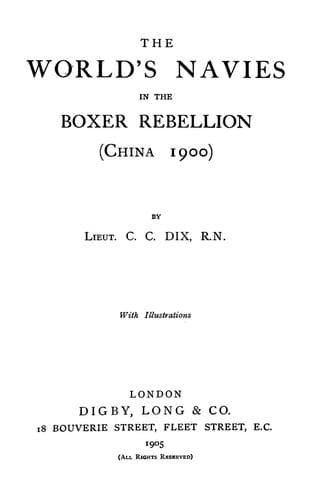
The world's navies in the Boxer rebellion (China 1900)Dix, Charles Cabry
History
The world's navies in the Boxer rebellion (China 1900)
Dix, Charles Cabry
China -- History -- Boxer Rebellion, 1899-1901
A more interesting, and, to the British, a much more satisfactory
affair, shortly happened at Shan-Hai-Kwan. This place is situated
between 150 and 200 miles to the north-eastward of Taku, and is
the site of some more very powerful forts. It is also a railway
terminus, and once had some slight strategical importance on account
of being the place where the Great Wall of China comes down to meet
the sea. It possesses no Naval value, being an open roadstead, and
ice-bound during the winter months. It became imperative to take the
forts on account of the valuable line of communication afforded by
the railway, and because of the possibility of the place becoming a
rallying centre for the enemy. The “Whens” and “Hows” were the reason
for many conferences between the Admirals; and it became evident
that, to them, it appeared to be a difficult and risky matter, and
one, moreover, likely to entail severe loss on the attacking fleet.
This conclusion having been arrived at, the difficulty arose of
choosing a leader who would make all the arrangements, and hold
himself responsible for the result.
[Illustration: H.M.S. “BARFLEUR.”
[_page 307._]
[Illustration: RAILWAY CROSSING GREAT WALL AT SHAN-HAI-KWAN.
[_page 306._]
I have heard, but refuse to be responsible for the statement, that
both the French and German admirals were asked if they would care
for the task, but declined on various grounds, and that then Sir
Edward Seymour was requested to deal with it, and at once accepted
the responsibility. What credence can be placed in the former part of
this I do not know, but the latter part of it is undoubtedly true,
and the British Commander-in-Chief took the work of organisation in
hand forthwith. As far as the arrangements became public, it was
believed that Admiral Seymour intended to employ none but armoured
ships for the bombardment, and the fleet would probably consist of
H.M.S. “Centurion,” “Barfleur,” and either “Aurora” or “Orlando,”
the first two being battleships and the others armoured cruisers;
“Navarin” and “Sissoi Veliky,” (Russian battleships), two German, one
French, “D’Entre Casteaux” one Japanese “Tokiwa” (armoured cruiser),
one Austrian battleship, and one Italian armoured cruiser, being
a total of, roughly speaking, a dozen heavily armed ships. Before
sailing, however, the “Pigmy,” a small gunboat, was sent on ahead,
with a political officer on board, who was told to endeavour to
parley with the Chinese commanding officer. So the little ship stood
right in under the forts and lowered a boat, when to the captain’s
surprise the Chinese were seen to be streaming out at the back of
the forts, and running up to the hills. He immediately grasped the
situation, and sent one officer and seventeen men ashore to garrison
the five big forts, and to hold them against all comers. He then
went back to Taku as fast as possible, and told the Admiral what
had happened. Was there ever such a ridiculous situation? The forts
Public-domain text, read in full here on John Shaqi.
Reviews
Reviews
No reviews yet
Be the first to share your thoughts on this work.
Elsewhere in the archive
Join the Discussion
Join the discussion
Sign in to leave a comment or review.
Sign InorCreate an account