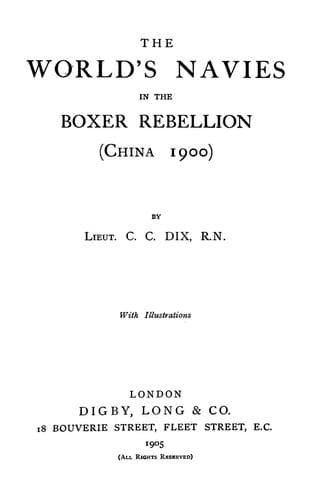
The world's navies in the Boxer rebellion (China 1900)Dix, Charles Cabry
History
The world's navies in the Boxer rebellion (China 1900)
Dix, Charles Cabry
China -- History -- Boxer Rebellion, 1899-1901
crossed the remaining plank and dragged it over, leaving just room
for the boat. Of course the officer and bluejackets embarked, and
told the Frenchmen to get to their side of the river over the boat;
but this led to such a storm of abuse from them, who had evidently
imagined that the British in their turn were going to replace the
plank, that the watch was again requisitioned, and, at the expiration
of the same interval of time, the boat went ahead, leaving two of the
five in safety, two in the water, and one cursing on the wrong side
of the river. Representations were made to the proper authorities
next day, and not only was a new bridge, capable of more easy
manipulation, built, but on subsequent passages the officer of the
boat met with nothing but civility.
A similar unpleasantness occurred to the first midshipman of the
boat—only on this occasion it was with the Russians, and diplomacy,
instead of high-handed dealing, in this case gained the day. The
same argument about right-of-way began one day, and it was not
until several hours had been wasted that the boat was allowed
to pass. Determined that this sort of thing should not happen
again, the midshipman, on his next arrival at Tientsin, obtained
an imposing-looking blue envelope, and having filled it with bulky
papers, wrote the Russian General’s name on it. Once more there was
the same difficulty, but after a lot of trouble the soldiers on guard
brought an officer who talked just enough English to understand what
the envelope purported to be. He was immediately all politeness, and
begged that he might have the supposed despatches, which he would
forward immediately; but, as they were not despatches at all—and even
if they had been, the officer might have forgotten to open the bridge
after all—the midshipman, while thanking him for his kindness, begged
him not to press the point, as he had had the strictest orders not to
let them out of sight until safely delivered. The bridge swung open,
the boat passed through, and so most probably did the “despatches,”
which were flung into the river when out of sight.
Three or four days after the army’s departure, the most extravagant
stories went round that 40,000 Boxers with guns were coming to attack
the settlement in a day or two. But few people believed this effort
of some one’s diseased imagination. It must be owned, however, that
another exodus of natives took place, many of whom were notably
faithful to their European masters, and who had in the past risked
much for their sake. At any rate, so persistent did the rumours
become, that it was decided to send a reconnaissance out to the
south-westward to gain some idea of their truth. Accordingly, a force
of cavalry—chiefly Americans, but partly Indian—was sent out to
discover what truth there might be in the matter.
Public-domain text, read in full here on John Shaqi.
Reviews
Reviews
No reviews yet
Be the first to share your thoughts on this work.
Elsewhere in the archive
Join the Discussion
Join the discussion
Sign in to leave a comment or review.
Sign InorCreate an account