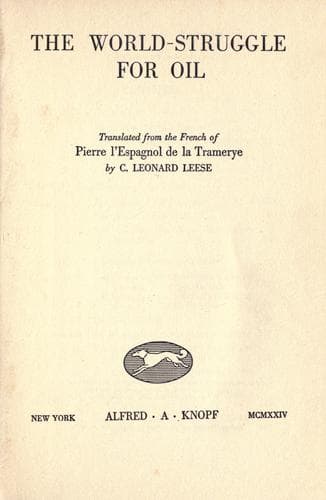
The World-Struggle for OilL'Espagnol de la Tramerye, Pierre Paul Ernest
History
The World-Struggle for Oil
L'Espagnol de la Tramerye, Pierre Paul Ernest
Petroleum; Petroleum industry and trade; War -- Economic aspects
Nevertheless, there is almost certainly oil in France, in the Ain
valley, the Jura Mountains, Auvergne, and the Landes; there is oil in
the French possessions in Northern Africa and in Madagascar; there
must be some in the Cameroons, in Indo-China, and in New Caledonia.
Is it not abnormal that the West Indies and Guiana, when in British
or American hands, produce oil, but when in French hands never yield
anything? The same applies to Oceania. But there is no reason to be
astonished at this; for, under the legislation which was in force
since 1810, no Frenchman had any inducement to search for oil. This
explains the epigram of one of the most important members of the French
cartel, when he declared that "the greatest misfortune that could
happen to an oil magnate in France would be to discover a spring of
oil." Happily, on March 22, 1922, the Chamber altered this state of
affairs by granting, as was suggested in the first edition of this
book, the guarantees which are indispensable to prospectors. Till that
year, the exploitation of deposits which a prospector had discovered
might be conceded to any foreign company which came on the scene at
the right moment to reap the fruits of his labours. Repayment of money
laid out was highly problematical, for the local authorities used to
grant this only to those responsible for the final investigations
leading directly to the discovery of oil. Now, hunting for a "wild
cat"--the American term for a boring--is a very risky operation,
which entails considerable expenditure. In a protest submitted to the
Ministry of Public Works by five Algerian colonists, who had carried
out explorations and borings upon land for which a concession was now
asked by a company of foreign origin, the colonists stated by affidavit
that they had spent 870,000 francs upon 14 borings and 85 wells, of
which seven alone were actually producing a few tons of petroleum.
Even so, the proportion of seven successful wells out of 85 is rather
high. O'Donnell, the president of the American Petroleum Institute,
estimates that, out of every hundred borings made, 98 are unprofitable.
But for fifty years the 2 per cent. which succeeded sufficed for the
consumption of the world.
The policy of France in the Near East since the War has been simply
one long suicide. Little by little, French diplomacy has abandoned
everything that was promised by the agreements of London. While the
San Remo Agreement marked the complete downfall of France in Asia, it
considerably strengthened the position of Britain: not only does it
recognize all rights acquired by Great Britain, including those which,
as in Mesopotamia, rested upon a highly insecure foundation, but it
gives British capitalists an important opening in French colonies which
are still almost untouched, whereas the corresponding advantages which
it confers upon France in some (not all) British colonies apply to
territories where the most desirable fields are already being exploited.
Public-domain text, read in full here on John Shaqi.
Reviews
Reviews
No reviews yet
Be the first to share your thoughts on this work.
Elsewhere in the archive
Join the Discussion
Join the discussion
Sign in to leave a comment or review.
Sign InorCreate an account