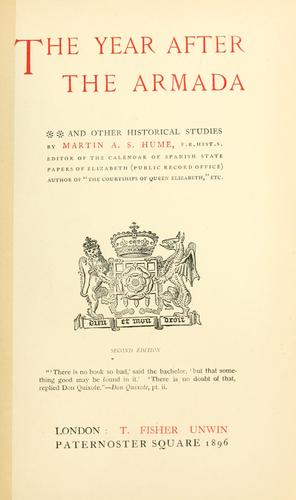
The Year after the Armada, and Other Historical StudiesHume, Martin A. S. (Martin Andrew Sharp)
Philosophy
The Year after the Armada, and Other Historical Studies
Hume, Martin A. S. (Martin Andrew Sharp)
Armada, 1588; Europe -- History -- 1517-1648; Europe -- History -- 17th century
No dead and gone human visage looms so clearly through the mist of ages
as that strange lymphatic face of Philip IV., which the genius of
Velazquez delighted to portray from youth to age. The smooth-faced
stripling in hunting dress, with his fair pink and white complexion,
his lank yellow hair, and his great mumbling Austrian mouth, shows more
plainly on canvas than he could have done whilst alive how weak of will
and how potent of passion he was, how easily he would be led by the
overbearing Count-Duke of Olivares to sacrifice all else for splendid
shows and sensuous indulgence; how his vanity would be flattered by
poets, painters, and players, whilst the world-wide empire of his
fathers was crumbling to nothingness {324} beneath his sway, and his
vassals were being robbed of their last maravedi to pay for the frenzy
of waste and prodigality with which Charles Stuart was entertained or a
royal wedding celebrated. Thenceforward, through his fastuous prime,
stately and splendid in his black satin and gold, to the time when, old
and disappointed, with forty years of disastrous domination, the rheumy
eyes drawn and haggard, but the head still erect, haughty and
unapproachable in its reserve, the great painter tells the King's story
better than any pen could write it. There is something not unlovable
in the shy, weak, poetic face, and one can pity the lad with such a
countenance who found himself the greatest king on earth at the age of
sixteen, surrounded by fawning flatterers and greedy bloodsuckers who
plunged him into a vortex of dissipation before his father's body was
cold in the marble sarcophagus at the Escurial. The old man's face,
too, cold and repellent as it is, shocking as are the ravages that time
and self-indulgence have stamped upon it, has yet in it an almost
plaintive despair that explains those terrible broken-hearted letters
in which the King, icy and undemonstrative as he was, poured out his
agony and sorrow undisguised for years to the only person in the wide
world he trusted, the nun Maria de Agreda.
Public-domain text, read in full here on John Shaqi.
Reviews
Reviews
No reviews yet
Be the first to share your thoughts on this work.
Elsewhere in the archive
Join the Discussion
Join the discussion
Sign in to leave a comment or review.
Sign InorCreate an account