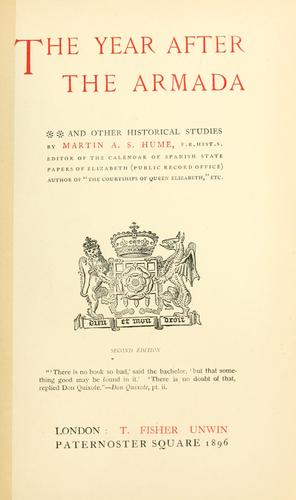
The Year after the Armada, and Other Historical StudiesHume, Martin A. S. (Martin Andrew Sharp)
Philosophy
The Year after the Armada, and Other Historical Studies
Hume, Martin A. S. (Martin Andrew Sharp)
Armada, 1588; Europe -- History -- 1517-1648; Europe -- History -- 17th century
So the little child is sent to Salamanca, and with him goes the
ponderously learned Dr. Cristobal Nuñez, who wraps up the simplest
facts in the most complicated and pedantic technical phraseology, and,
what is far more troublesome for the present purpose, writes a
shockingly bad hand. His first document is a microscopic report of the
constitution and temperament of the child, and the simple history of
his baby ailments. The description is most curious; and, if any doubt
existed as to his paternity, every trait indicates the character and
appearance of a son of the sovereign race of Austria. "He is," says
the learned doctor, "of melancholic, choleric temperament, wilful and
passionate, but playful when he is pleased, and respectful to those he
thinks his superiors. He is of sound constitution, being the offspring
of young and healthy parents; possesses superior intelligence for his
age; a wonderful memory, which gives great hope if he be well trained.
He is slow of speech, and expresses himself with great difficulty,
stuttering and lisping; and is so backward on his feet that he has only
just learnt to walk. His person is so perfect and beautiful, that the
mind of a sculptor never imagined anything better; he has a lovely,
fair, red and white complexion, and full grey eyes. He is grave and
thoughtful--not dull or sad, but full of childish humour; quick to
laugh and quick to cry. He is," says the doctor, "high of spirit,
courageous, and {336} pugnacious, impatient of contradiction; and, if
his speech be not at once understood, he flies into such ungovernable
rage as to make it dangerous to thwart him, and he should rather be
coaxed to obedience than forced."
Like all his forbears, he is described as a great eater, and very fond
of sweets; and it is not surprising to learn that he has all his short
life suffered from over-eating and indigestion, and for long past has
had quartan ague. The drastic remedies of the times were endured by
the child, the doctor says, "without weeping, as if he knew they were
for his good"; but the learned medico confesses that all his own
prescriptions had done the babe less good than what he describes as an
old wife's remedy of anointing the stomach and spine with ointment and
saffron.
Public-domain text, read in full here on John Shaqi.
Reviews
Reviews
No reviews yet
Be the first to share your thoughts on this work.
Elsewhere in the archive
Join the Discussion
Join the discussion
Sign in to leave a comment or review.
Sign InorCreate an account