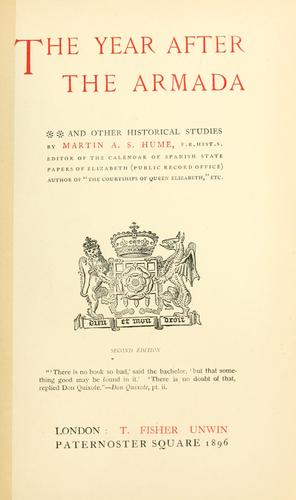
The Year after the Armada, and Other Historical StudiesHume, Martin A. S. (Martin Andrew Sharp)
Philosophy
The Year after the Armada, and Other Historical Studies
Hume, Martin A. S. (Martin Andrew Sharp)
Armada, 1588; Europe -- History -- 1517-1648; Europe -- History -- 17th century
The next document of the series is a letter, elated nearly four years
afterwards, March 17, 1634, from the Secretary of State, Geronimo
Villanueva, to Don Juan Isassi Ydiaquez, saying that his Majesty had
received with the deepest grief the news of the death of Don Francisco
Fernando, who showed such bright promise for his tender years, and his
Majesty highly appreciates all the care that has been taken of his
education. The body is to be brought with the utmost secrecy in a
coach to the royal monastery of {340} St. Lorenzo (the Escurial), where
it is to be buried, and advice is to be sent by confidential special
messenger to Madrid when the corpse should arrive, in order that one of
the King's stewards may be there to receive it. All the other
arrangements for the burial are made. The four years had apparently
not been unprofitable ones to the hidalgo, as the next time his name
appears he is a knight of Santiago and lord of the town of Ameyo, as
well as of the castles of Isassi and Orbea. The date of the document
is April 15, 1634, and again it is a notarial deed attested by the
prothonotary of the kingdom, Don Geronimo Villanueva, setting forth
that Don Juan Isassi Ydiaquez delivered the body of Don Francisco
Fernando, son of his Catholic Majesty Philip IV., whom God had taken to
himself, to the Marquis of Torres, the Bishop of Avila, and other
nobles appointed by the King to receive it. The delivery was made in
the porch of the cathedral, and we are told that the corpse was dressed
in a red gown, bordered with gold, and lay in a coffin of black velvet.
The coffin, which had been borne by Don Juan Isassi and his servant to
the porch, was thence carried to the great hall of the monastery by
certain of the King's gentlemen-in-waiting, and after the religious
ceremonies had been performed, was taken to the vault by the monks of
the Order and laid to rest. And so ended a little life which, like
that of his half-brother Baltasar, if it had been spared, might have
stayed the decay of the Spanish branch of the House of Austria. It is
true that Don John of Austria survived, and for a short time snatched
his poor brother, Charles the Bewitched, from the clutches of {341} his
foolish mother and her low-born favourite, Valenzuela, but who knows
whether the strong, masterful spirit of the baby of four whom it was
dangerous to thwart might not, if he had grown to manhood, have done
more than his younger brother to keep the reins of power when once he
grasped them. Poor trembling, white-faced Charles the Bewitched, with
his leaden eyes and monstrous projecting jaw, a senile dodderer at
thirty, wanted a strong, masterful spirit like this to hold him up and
shield him from the vultures that fought over the carcase before the
poor creature was dead.
Public-domain text, read in full here on John Shaqi.
Reviews
Reviews
No reviews yet
Be the first to share your thoughts on this work.
Elsewhere in the archive
Join the Discussion
Join the discussion
Sign in to leave a comment or review.
Sign InorCreate an account