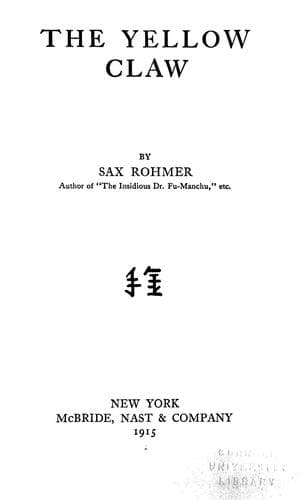
Detective and mystery stories; Hoodlums -- Fiction; London (England) -- Social life and customs -- Fiction; Murder -- Fiction
Denise Ryland had been very voluble at the commencement of the drive,
but, as it progressed, had grown gradually silent, and now sat with
her brows working up and down and with a little network of wrinkles
alternately appearing and disappearing above the bridge of her nose. A
self-reliant woman, it was irksome to her to know herself outside the
circle of activity revolving around the mysterious Mr. King. She had had
one interview with Inspector Dunbar, merely in order that she might give
personal testimony to the fact that Mira Leroux had not visited her
that year in Paris. Of the shrewd Scotsman she had formed the poorest
opinion; and indeed she never had been known to express admiration for,
or even the slightest confidence in, any man breathing. The amiable M.
Gaston possessed virtues which appealed to her, but whilst she admitted
that his conversation was entertaining and his general behavior good,
she always spoke with the utmost contempt of his sartorial splendor.
Now, with the days and the weeks slipping by, and with the spectacle
before her of poor Leroux, a mere shadow of his former self, with the
case, so far as she could perceive, at a standstill, and with the police
(she firmly believed) doing “absolutely... nothing... whatever”--Denise
Ryland recognized that what was lacking in the investigation was that
intuition and wit which only a clever woman could bring to bear upon it,
and of which she, in particular, possessed an unlimited reserve.
The car sped on toward the purer atmosphere of the riverside, and even
the clouds of dust, which periodically enveloped them, with the passing
of each motor-'bus, and which at the commencement of the drive had
inspired her to several notable and syncopated outbursts, now left her
unmoved.
She thought that at last she perceived the secret working of that
Providence which ever dances attendance at the elbow of accomplished
womankind. Following the lead set by “H. C.” in the Planet (“H. C.” was
Helen Cumberly's nom de plume) and by Crocket in the Daily Monitor, the
London Press had taken Olaf van Noord to its bosom; and his exhibition
in the Little Gallery was an established financial success, whilst “Our
Lady of the Poppies” (which had, of course, been rejected by the Royal
Academy) promised to be the picture of the year.
Mentally, Denise Ryland was again surveying that remarkable composition;
mentally she was surveying Olaf van Noord's model, also. Into the scheme
slowly forming in her brain, the yellow-wrapped cigarette containing
“a small percentage of opium” fitted likewise. Finally, but not last in
importance, the Greek gentleman, Mr. Gianapolis, formed a unit of the
whole.
Public-domain text, read in full here on John Shaqi.
Reviews
Reviews
No reviews yet
Be the first to share your thoughts on this work.
Elsewhere in the archive
Join the Discussion
Join the discussion
Sign in to leave a comment or review.
Sign InorCreate an account