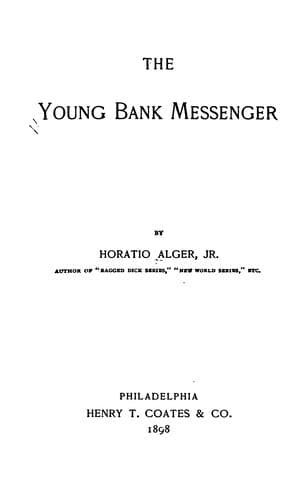
Conduct of life -- Fiction; Criminals -- Fiction; Inheritance and succession -- Fiction
Of the many boys with whom Frank was associated not one suspected that
the attractive lad, who was a favorite with all, was a son of the
noted desperado whose deeds had been commemorated in dime novels and
were a matter of common knowledge in the West. Ernest had cautioned
the boy to say as little as possible of his past history.
Years have gone by, and what Bolton predicted has come to pass. Ernest
is a young man, a college graduate, and he will soon be married to a
young lady of high position in the city of New York. He will go abroad
for a year, and on his return will take up his home on his ancestral
estate.
Last week he received a letter from a patient in a New York City
hospital. It was signed John Franklin, a name with which he was not
familiar.
In some wonder he answered the call, and was led to a bed on which lay
a gaunt, spectral man, evidently in the last stage of existence.
"Is this John Franklin?" asked Ernest, doubtfully.
"That is the name I go by now," answered the dying man.
"Do I know you? Have I ever met you?"
"Yes."
"I don't remember you."
"If I tell you my real name, will you keep it secret?"
"Yes."
"Then I am John Fox."
"What! the noted outlaw?"
"I am all that is left of him. You will not betray me?"
"No; certainly not. Can I do anything for you?"
"Yes; you were left the guardian of my brother's child?"
"Yes."
"Is he alive? Is he well?"
"Yes."
"Will you bring him here? Will you let me see him before I die?"
"I will. I cannot refuse the request of a dying man."
So Ernest brought Frank to the bedside of his dying uncle. It was a
sad interview. Frank was moved, but John Fox, seeing him strong,
handsome, robust, felt comforted.
"He at least has profited by the fate that overtook his father and
myself. I shall die content, for I leave him in good hands. Don't let
him think too hardly of us!"
"I will not. And so far as I can compass it, his future life shall be
happy."
The dying outlaw reached out his hand and pressed Ernest's gratefully.
A day later, and he was dead.
THE JOHN C. WINSTON CO.'S POPULAR JUVENILES.
L. T. TROWBRIDGE.
Neither as a writer does he stand apart from the great currents of
life and select some exceptional phase or odd combination of
circumstances. He stands on the common level and appeals to the
universal heart, and all that he suggests or achieves is on the plane
and in the line of march of the great body of humanity.
Public-domain text, read in full here on John Shaqi.
Reviews
Reviews
No reviews yet
Be the first to share your thoughts on this work.
Elsewhere in the archive
Join the Discussion
Join the discussion
Sign in to leave a comment or review.
Sign InorCreate an account