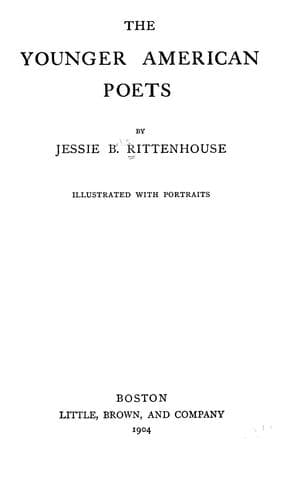
The Younger American PoetsRittenhouse, Jessie Belle
History
The Younger American Poets
Rittenhouse, Jessie Belle
American poetry -- History and criticism; Poets, American
THAT genial and delicate satirist, Miss Agnes Repplier, laments in one
of her clever essays that our modern poets incline to dwell upon the
sombre side of things, and hence contribute so little to the cheer of
life. One cannot but wonder what poetry Miss Repplier has been
reading, for our own acquaintance with the song of to-day has been so
much the opposite that it is difficult on the spur of the moment to
recall any poet of the present group in America whose work is not in
the main wholesome and heartening and who is not facing toward the
sun. To be sure, there must be the relief of shade, lest the light
glare; but they who journey to Castaly are in general cheerful
wayfarers, taking gladly the gift of the hours and rendering the Giver
a song, and among the blithest of them is Clinton Scollard, to whom
life is always smilingly envisaged, and to whom, whether spring or
autumn betide, it is still the “sweet o’ the year.”
[Illustration: Clinton Scollard]
If Mr. Scollard’s way has ever been “through dolor and dread, over
crags and morasses,” he is too much the optimist to let the fact be
known, or, better still, to recognize it as such; for we see what our
own eyes reflect from within, and it is certain that Mr. Scollard’s
outlook upon life is governed by the inherent conviction that her ways
are ways of pleasantness and all her paths are peace. Possibly this
conviction would have more value to the less assured nature if the
testimony of its winning were set down as a strength-giving force by
the way, as we incline in daily life to undervalue the amiability and
cheer which are matters of birthright rather than of overcoming; but
this is a standard narrow in itself and wide of the issue at stake,
which is so much cheer _per se_, whether the fortunate dower of
nature, or the alchemic result of experience; nor may one draw too
definite a line between the temperamental gift and the spiritual
acquisition, especially when the psychology of literature furnishes
the only data. It is sufficient to note the result in the work, and
its bearing upon the art which shapes it. To Mr. Scollard, then,
“Life’s enchanted cup” not only “sparkles at the brim;” but when he
lifts it to his lips a rainbow arches in its depths, and he has
communicated to his song the flash of sunshine and color sparkling in
the clearness of his own draught of life.
Public-domain text, read in full here on John Shaqi.
Reviews
Reviews
No reviews yet
Be the first to share your thoughts on this work.
Elsewhere in the archive
Join the Discussion
Join the discussion
Sign in to leave a comment or review.
Sign InorCreate an account