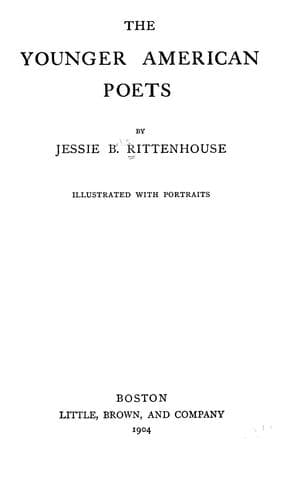
The Younger American PoetsRittenhouse, Jessie Belle
History
The Younger American Poets
Rittenhouse, Jessie Belle
American poetry -- History and criticism; Poets, American
It is difficult to choose from the several volumes portraying Oriental
life, such poems as shall best represent it, since in any direction we
shall find a picture full of color and of strange new charm: the white
mosques and minarets; the gardens of citron and pomegranate; the
bazaars, with their rare fabrics and curios; the pilgrims, dozing in
the shade of the temples; the Bedouins, riding in from the desert; the
women carrying from the springs their water-jars. We shall hear the
sunrise cry of the muezzin from the minarets; the zither and lute in
the gardens at evening; the jargon of tongues in booth and
market-place; the philosopher expounding the Koran; the lover singing
the songs of Araby. The dramatic life of that impulsive, passionate
people will be seen in such poems as the “Dancing of Suleima,” “At the
Tomb of Abel,” and “Yousef and Melhem,” and the philosophical side in
many a poem translating the precepts of the Koran into action; but it
is, after all, for the picture in which all this is set that one comes
with chief pleasure to these songs. Not only the human element of that
strangely fascinating life is incorporated in them, but all the
phenomena of nature in its swift-changing moods pass in review before
one’s eyes, particularly of the swift transitions of the desert sun,
stayed by no detaining cloud, and followed by the immediate gloom of
night. The graphic lines—
When on the desert’s rim,
In sudden, awful splendor, stood the sun—
are excelled in terse, pictorial force by the record of its setting,—
Then sudden dipped the sun.—
Nor easily forgotten are those pictures of lying in the open when the
cooling dark had fallen upon the yearning land, or upon the hills when
The night hung over Hebron all her stars,
Miraculous processional of flame,
and below from out the “purple blur” rose the minarets of the mosque
where
Sepulchred for centuries untold,
The bones of Isaac and of Joseph lay;
And broidered cloths of silver and of gold
Were heaped and draped o’er Abraham’s crumbled clay.
In _The Lutes of Morn_ there are two sonnets—though lyrics in effect,
so does the song prevail with Mr. Scollard—that serve hastily to
sketch a moving scene and in their touch bring to mind Paul the
chronicler. The first is “Passing Rhodes,” and contains these lines
with a biblical tang,
At day’s dim marge, hard on the shut of eve,
We rocked abreast the rugged Rhodian isle,
which tang appears in stronger flavor in the racy opening of the
following:
Public-domain text, read in full here on John Shaqi.
Reviews
Reviews
No reviews yet
Be the first to share your thoughts on this work.
Elsewhere in the archive
Join the Discussion
Join the discussion
Sign in to leave a comment or review.
Sign InorCreate an account