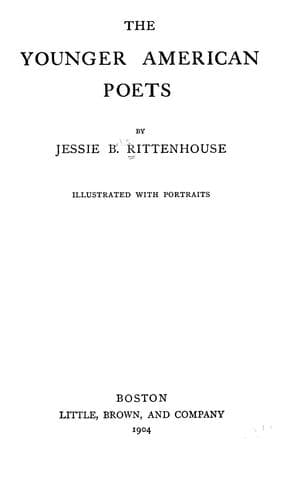
The Younger American PoetsRittenhouse, Jessie Belle
History
The Younger American Poets
Rittenhouse, Jessie Belle
American poetry -- History and criticism; Poets, American
Of the lighter notes, upon love and kindred themes, Mr. Scollard has
many in his poems of the Orient; “The Song of the Nargileh” is of
especial charm, but unfortunately too long to quote. Very graceful,
too, is the “Twilight Song” with one of Mr. Scollard’s graphic
beginnings, but one quaint bit from _The Lutes of Morn_ is so
characteristic as showing Oriental felicity of speech that while
merely a jotting in song, and less important in an artistic sense than
many others touching upon the theme of love, I cannot refrain from
citing it instead: it is called “Greetings—Cairo.”
Upon El Muski did I meet Hassan,
Beneath arched brows his deep eyes twinkling bright,
Good dragoman (and eke good Mussulman)
And cried unto him, “May your day be white!”
“And yours, howadji!” came his swift reply,
A smile illumining the words thereof,
(All men are poets ’neath that kindling sky),
“As white as are the thoughts of her you love!”
The Oriental poems cover not only a varied range of subject, but pass
in review nearly every important city and shrine in the length and
breadth of that storied land, making poetical footnotes to one’s
history and filling his memory with pictures.
The second source of Mr. Scollard’s inspiration, doubtless the first
in point of time, is his delight in nature. Here, too, the objective
side predominates. He is footfaring, with every sense alert to see, to
hear, and to enjoy; he slips the world of men as a leash and becomes
the fetterless comrade of the vagrant things of earth. He stops to do
no philosophizing by the way,—the analogies, the laws, the evolving
purposes of nature, are rarely touched upon in his verse; nor is he
one of the poet-naturalists, intent to observe and record with
infinite fidelity the fact, with its mystic spirit of beauty. He finds
in the obvious side of nature such glamour and magic as suffice for
inspiration and delight; and it is this side which enthralls him
almost wholly. In other words, his nature vision is rather outlook
than insight, though always sympathetic in fancy and delicate in
touch. He seems to see only the gladness in the season’s phases, and
greets white-shrouded winter with all the ardor that he would bestow
upon flower-decked June.
He has one volume entitled _Footfarings_, written partly in prose and
partly in verse,—a book abrim with morning joy, and bringing with it
the aroma of wood-flowers and the minstrelsy of birds. The prose
predominates, and is worthy the pen of a poet: its imaginative grace,
its enthusiasm, and its quaint and delicate fancy impart to it all the
flavor of poetry while adhering to a crisp and racy style. Each
chapter is prefaced by a keynote of verse, such as that which conducts
one to the haunt of the trillium, where
These nun-like flowers with spotless urns,
That shine with such a snowy gloss,
Will seem, amid the suppliant ferns,
To bow above the cloistral moss.
Public-domain text, read in full here on John Shaqi.
Reviews
Reviews
No reviews yet
Be the first to share your thoughts on this work.
Elsewhere in the archive
Join the Discussion
Join the discussion
Sign in to leave a comment or review.
Sign InorCreate an account