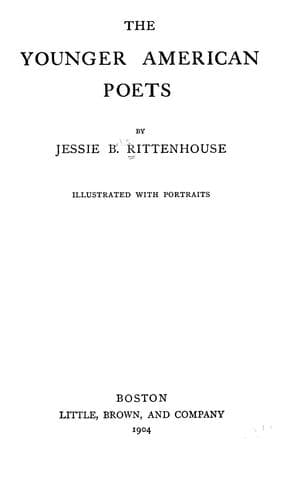
The Younger American PoetsRittenhouse, Jessie Belle
History
The Younger American Poets
Rittenhouse, Jessie Belle
American poetry -- History and criticism; Poets, American
Balladry furnishes the third source of Mr. Scollard’s singing impulse.
The Oriental poems have somewhat of this phase of his work, though
more especially inclining to the narrative style; and the epic poem
“Skenandoa,” while written in a story-lyric, shows the ballad-making
qualities, which in their true note had been heard earlier in
“Taillefer the Trouvère,” and have been heard more definitely in
_Ballads of Valor and Victory_, recently written in collaboration with
Mr. Wallace Rice, and reciting the heroisms and adventures of soldier,
sailor, and explorer from Drake to Dewey.
Ballad-writing is an art calling for distinct gifts. The dramatic
element must predominate. The story first—and if this be colorless,
there is no true ballad; the verse next—and if this be flaccid, or if
it swing to the other extreme and become too strained and tense, there
is no true ballad; for the essence of ballad-writing is in the freedom
of the movement, the swing and verve with which one recounts a
picturesque story. Mr. Scollard’s contributions to the volume are sung
with spontaneity and with a virile note, and in the matter of
characterization, fixing the personality of the hero before the mind,
the work is especially strong; witness “Riding With Kilpatrick;”
“Wayne at Stony Point;” “Montgomery at Quebec;” the picture of Thomas
Macdonough at the Battle of Plattsburg Bay, or in more recent times of
“Private Blair of the Regulars,” the modern Sidney, who, dying, gave
the last draught of his canteen to his wounded fellows.
“The White November” and “The Eve of Bunker Hill” are among the best
of the ballads. The former brings with it a well-known note, but one
newly bedight with brave phrase; indeed, all the celebrated ballad
measures appear in these song stories, but well individualized in
diction and dramatic mood. They differ of course in the degree of
these qualities; some have too slight an incident to chronicle; some
might with better effect have been omitted, particularly “War in
April,” by Mr. Rice; but for this he atones by “The Minute-Men of
Northboro” and other vigorous contributions to the collection. The
ballads have the merit of structural compactness. While the necessary
portrayal of the incident renders many of the best of them too long to
quote, there are, in Mr. Scollard’s contribution to the book, few
superfluous stanzas; each plays its essential part in the development
of the story. They may not, then, be quoted without their full
complement of strophes, which debars us from citing the “White
November,” “Wayne at Stony Point,” and others mentioned as most
representative; but here is the tale of “Riding With Kilpatrick,” not
more valiant than many of the others, but celebrating a picturesque
figure. There are certain reminiscent notes of “How They Brought the
Good News from Ghent to Aix” in this galloping anapestic measure; and
its graphic opening line calls to mind that instantaneous picture, “At
Aershot, up leaped of a sudden the sun.”
Public-domain text, read in full here on John Shaqi.
Reviews
Reviews
No reviews yet
Be the first to share your thoughts on this work.
Elsewhere in the archive
Join the Discussion
Join the discussion
Sign in to leave a comment or review.
Sign InorCreate an account