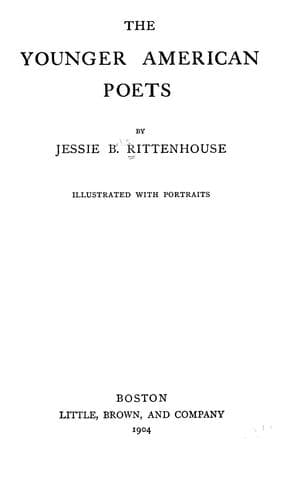
The Younger American PoetsRittenhouse, Jessie Belle
History
The Younger American Poets
Rittenhouse, Jessie Belle
American poetry -- History and criticism; Poets, American
It is more or less an easy artifice for the dramatist to reduce his
hero to the verge of despair just as his heroine is conveniently near
to save him from leaping over a precipice; but artifice becomes art
when the impalpable emotions of a nature lost almost to its own
consciousness begin to be called from diffusion and given direction
and meaning. While the characterization of Perth is not altogether
free from strained sentiment, one recognizes in it a higher
achievement than went to the making of the more spectacular crises of
the play. The dramatic materials of _El Dorado_ are in the main
skilfully handled, and there is logical congruity in the situations as
they evolve, assuming the premise of the plot. As an acting play,
however, it would require the further introduction of women
characters, Beatrix sustaining alone, in its present cast, the
feminine element of the drama.
As to the play as literature, as poetry, there is much to commend, and
somewhat to deplore. If it remain as literature, it must contain
elements that transcend those of its action; if a well-developed plot
were literature, then many productions of the stage that are purely
ephemeral would take their place as works of art. Between the dramatic
and the theatrical there is a nice distinction, and only an artist may
wholly avoid the pitfalls of the latter. Mr. Torrence’s drama seems to
me to blend the two qualities. For illustration the following
outpouring of Coronado, when he returns for a last hour with Beatrix,
then disguising to follow his army, and finds her faithless to the
tryst, is purely melodramatic. The Friar Ubeda reminds him that the
trumpets call him, whereupon Coronado exclaims:
It is no call, but rather do their sounds
Lash me like brazen whips away from her.
They shriek two names to me, Honour and Hell;
They drive me with two words, Duty and Death.
These are the things that I can only find
Outside her arms.
In the same scene, however, occurs this fine passage, compact of
hopelessness, and having in it the whole heart-history of Perth, who
speaks it. He is urged by the friar to hasten that they may join the
expedition as it passes the walls:
PERTH. It would be useless.
UBEDA. In what way?
PERTH. If to go would be an ill,
I need not hasten; it will come to me.
And if a good, they will have gone too far;
I could not overtake them.
This passage recalls another memorably fine,—that in which Perth upon
his release would return to his dungeon, being oppressed by the light:
I seem to have to bear the sky’s whole arch,
Like Atlas, on my shoulders.
Public-domain text, read in full here on John Shaqi.
Reviews
Reviews
No reviews yet
Be the first to share your thoughts on this work.
Elsewhere in the archive
Join the Discussion
Join the discussion
Sign in to leave a comment or review.
Sign InorCreate an account