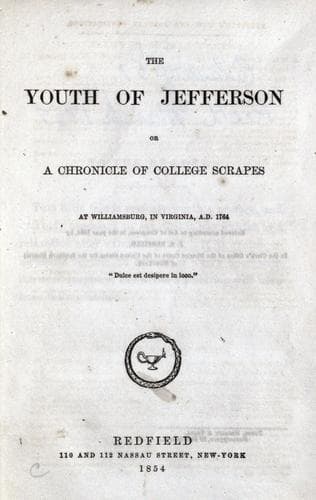
The Youth of Jefferson: Or, a Chronicle of College Scrapes at Williamsburg, in Virginia, A.D. 1764Cooke, John Esten
General
The Youth of Jefferson: Or, a Chronicle of College Scrapes at Williamsburg, in Virginia, A.D. 1764
Cooke, John Esten
Jefferson, Thomas, 1743-1826 -- Fiction
"At any rate, you are not sorry," said Sir Asinus, sighing; "and I
return the compliment. I myself am not sorry to part with the unworthy
men who have misunderstood me, and persecuted me. A martyr to
political ideas--to love for my country--I go to foreign lands to seek
a home."
And having uttered this melancholy sentence, the woful knight twirled
his thumbs, and sighed piteously.
As for Jacques, he smiled.
"When do you leave?" he said.
Sir Asinus pointed to the placard.
"On the morrow?"
"Yes."
"Well, there is time yet to attend the May-festival at Shadynook. Come
along."
"No, no," said Sir Asinus, sighing; "no, I thank you. I have had all
my noble aspirations chilled--my grand ideas destroyed; my heart is no
longer fit for merriment. I depart."
And rising, Sir Asinus seated himself upon the table disconsolately.
Jacques looked at him and smiled.
"Do you know, my dear Asinus," he said, "that you present at this
moment the grandest and most heroic picture? When a great man suffers,
the world should weep."
"Instead of which, you laugh."
"I? I am not laughing."
"You are smiling."
"That is because, for the first time in my life, I am nearly happy."
"Happy? Would that I were! Happy? It is a word which I seldom have use
for," said Sir Asinus, dangling his legs and sighing piteously.
"Why not endeavor to use it?"
"I cannot."
"Come and laugh with us at Shadynook."
"I no longer laugh."
"You weep?"
"No: my grief is too deep for tears--it is dried up--I mean the
tears."
"Poor fellow!"
"There you are pitying my afflictions--spare me!"
"I do pity you. To see the noble and joyous Sir Asinus grow
melancholy--to see those legs, which erst glided through the minuet
and reel, now dangling wearily--to see that handsome visage so drawn
down; is there no occasion for pity?"
And Jacques sighed.
"Well, well," said Sir Asinus, "I am glad you came, spite of your
unworthy banter, you unfeeling fellow. I wish to send some messages to
my friends."
"What are they?"
"First, to Belle-bouche--love and remembrance."
"That is beautiful; and I never knew these words yet fail to touch the
heart."
"To all the boys, the fond regards of him who goes from them--a martyr
to the attempt to uphold their rights."
"That is affecting too."
"To the little dame who passed with you some days ago--Miss Martha
Wayles by name--but no; nothing to her."
And Sir Asinus groaned.
"Nothing?" said Jacques.
"No; the memory of my love for her shall never grieve her; let us say
no more, Jacques, my friend. I have finished."
"And what do you leave to me?" said Jacques.
"My affection."
"I would prefer that violin."
"No, no, my friend; it will comfort me on my voyage. Now farewell!"
"Shall I see you no more?"
"No more."
"Why?"
"Do I not depart to-day?"
"True, true," said Jacques; "and if you really must go, farewell.
Write to me."
"Let us embrace."
"Willingly."
And Sir Asinus caught his friend in his arms and sniffled.
Public-domain text, read in full here on John Shaqi.
Reviews
Reviews
No reviews yet
Be the first to share your thoughts on this work.
Elsewhere in the archive
Join the Discussion
Join the discussion
Sign in to leave a comment or review.
Sign InorCreate an account