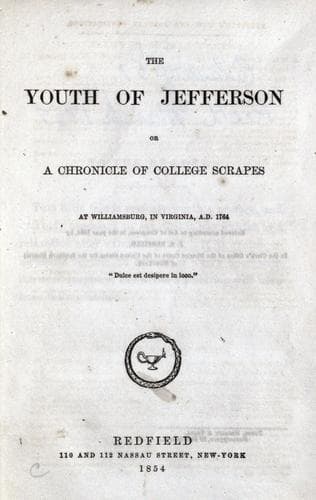
The Youth of Jefferson: Or, a Chronicle of College Scrapes at Williamsburg, in Virginia, A.D. 1764Cooke, John Esten
General
The Youth of Jefferson: Or, a Chronicle of College Scrapes at Williamsburg, in Virginia, A.D. 1764
Cooke, John Esten
Jefferson, Thomas, 1743-1826 -- Fiction
As he entered Williamsburg, he came very near being overturned by a
gentleman who was leaving that metropolitan city, at full gallop.
"Hey!" cried this gentleman, reining up; "why, good day, Mowbray!"
And Sir Asinus made a bow of grotesque respect.
"Whither away, my dear fellow--to that den of iniquity, the grammar
school, eh?"
"Yes," said Mowbray, smiling; "and you?"
"I go to other fields and pastures new--to those Hesperian gardens
famed of old, and so forth. Come with me!"
"No, thank you. I suppose you are going to see a lady?"
"Precisely; and now do you still refuse?"
"Yes."
"You are an ungallant book-worm, a misogynist--and that is the next
thing to a conspirator. Leave your books, and come and taste of sylvan
joys."
"Where are you going?"
"To see Dulcinea."
"Who is she?"
"Her other name is Amaryllis."
"Well, sing to her," said Mowbray; "for my part, I am going to visit
Plato, Justinian, Blackstone, whose lectures are better than Virgil's
heroics, and Coke, who is more learned, if not more agreeable, than
any Hesperians. Farewell."
And Mowbray saluted Sir Asinus with a smile, and rode on. The knight
returned his salute, and continued his way in the opposite direction.
Now, as our history concerns itself rather with Amaryllis than Plato
or Coke, we shall permit Mowbray to go on, and retracing our steps,
follow Sir Asinus to his destination.
Sir Asinus on this morning is magnificent, and finds the air very
pleasant after his long imprisonment. He inhales it joyously, and in
thought, nay, often in words, invokes confusion on the heads of
proctors. He is in full enjoyment of those three great rights for
which he has sacrificed so much--namely, life, liberty, and the
pursuit of happiness.
He is joyous, for he has stolen a march upon the watchful guardians of
the college; he revels in the sentiment of freedom; and believes
himself in pursuit of that will o' the wisp called happiness.
He sings, as he goes onward on his hard-trotting courser, the words of
that song which we have heard him sing before:
"Hez! sire asne! car chantez
Belle bouche rechignez;"
and is not mortified when a donkey in the neighboring meadow brays
responsively.
He bends his steps toward Shadynook, where he arrives as the matutinal
meal is smoking on the board; and this Sir Asinus partakes of with
noble simplicity. One would have imagined himself in presence of
Socrates dining upon herbs, instead of Sir Asinus comforting his inner
man with ham and muffins.
After breakfast, Aunt Wimple, that excellent old lady whose life was
completely filled by a round of domestic duties, banished her visitor
to the sitting-room. To make his exile more tolerable, however, she
gave him Belle-bouche for a companion.
Public-domain text, read in full here on John Shaqi.
Reviews
Reviews
No reviews yet
Be the first to share your thoughts on this work.
Elsewhere in the archive
Join the Discussion
Join the discussion
Sign in to leave a comment or review.
Sign InorCreate an account