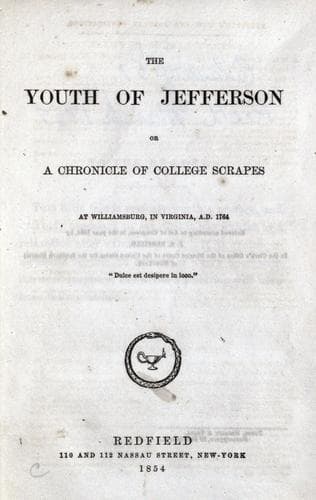
The Youth of Jefferson: Or, a Chronicle of College Scrapes at Williamsburg, in Virginia, A.D. 1764Cooke, John Esten
General
The Youth of Jefferson: Or, a Chronicle of College Scrapes at Williamsburg, in Virginia, A.D. 1764
Cooke, John Esten
Jefferson, Thomas, 1743-1826 -- Fiction
"Ah, well, Charles," continued Ernest, "we ought to rejoice in the
warmth, inasmuch as it is better for the poor than cold--the winter.
Let us not complain."
"I do not; but I see precious few poor about now: they all seem to be
rejoicing, without needing any assistance therein from us. Look at
that fine chariot."
"At Madam Finette's door?"
"Yes."
"I think I recognise the driver--Tom, from Mrs. Wimple's," said
Mowbray calmly.
"Mrs. Wimple--who is she?"
"A lady, at whose house I suffered one of my cruellest
disappointments," said Mowbray with a shadowed brow; "let us not
speak of that!"
"Of what?"
"You do not understand?"
"I? Of course not."
"It was there that I was told, by the woman I loved, how despicable I
was," said Mowbray with a cruel tremor of his pale lip.
"Oh--yes--pardon me," Hoffland said; and turning aside his head, he
murmured, "Men--men! how blind you are! yes, high-gravel blind!" and
looking again at Mowbray, Hoffland perceived that his face had become
calm again.
"I promised Lucy to bring home some little articles from this place,"
he said calmly; "go in with me a moment, Charles."
Hoffland drew back.
"No," he said; "I believe--I have--I think I'd rather not."
"I will detain you but a moment."
Hoffland's glance plunged itself into the interior of Madam Finette's
emporium; and the consequence was that the young gentleman retreated
three steps.
"I don't think I have time," he said laughing; "but I'll wait for you
here: the sun is warm, but I can easily protect my face by holding my
handkerchief to it."
And taking up his position in the vestibule, so to speak, of the shop,
Hoffland placed himself as much out of view as possible, and waited.
Spite of the fact that the sun's rays did not penetrate to the spot
which he occupied, the white handkerchief was still used as a shade.
Mowbray entered and approached Madam Finette.
But that lady was busy; her counter was covered with magnificent
silks, ribbons, velvets and laces, which she was unrolling, folding
up, drawing out, and chattering about, as fast as her small hands and
agile tongue would permit. Before her stood a lady, who, accompanied
by her cavalier, was engaged in the momentous task of making up her
mind what colors of velvet and satin ribbon she should select.
The lady was young and smiling--cheerful and graceful. When she
laughed, the musical chime of the timepiece overhead was drowned, and
died away; when she smiled, the sunlight seemed to have darted one of
its brightest beams into the shop. The gentleman was elegant and
melancholy: he looked like Endymion on Latmos trying to recall his
dream, or like Narcissus fading into shadow. His costume resembled a
variegated Dutch tulip; his hair was powdered to excess; he sighed and
whispered sadly, and looked at the lady.
The lady was called Belle-bouche, Belinda, or Rebecca.
The gentleman was familiarly known as Jacques.
"I think that would suit you," sighed Jacques.
Public-domain text, read in full here on John Shaqi.
Reviews
Reviews
No reviews yet
Be the first to share your thoughts on this work.
Elsewhere in the archive
Join the Discussion
Join the discussion
Sign in to leave a comment or review.
Sign InorCreate an account