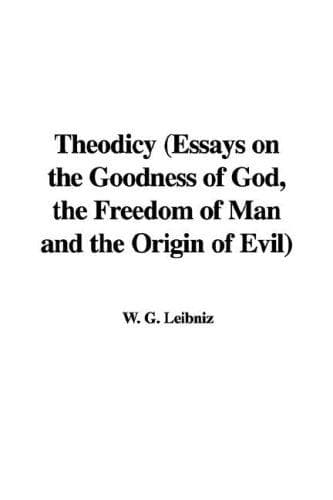
Theodicy: Essays on the Goodness of God, the Freedom of Man and the Origin of EvilLeibniz, Gottfried Wilhelm, Freiherr von
Religion
Theodicy: Essays on the Goodness of God, the Freedom of Man and the Origin of Evil
Leibniz, Gottfried Wilhelm, Freiherr von
Free will and determinism; Theism; Theodicy
Deorum_, with regard to the evasions of the Epicureans expressed the sound
opinion (as M. Bayle observes towards the end of the same page) that it
would be much less shameful to admit that one cannot answer one's opponent,
than to have recourse to such answers. Yet we shall see that M. Bayle
himself confused the certain with the necessary, when he maintained that
the choice of the best rendered things necessary.
170. Let us come now to the possibility of things that do not happen, and I
will give the very words of M. Bayle, albeit they are somewhat discursive.
This is what he says on the matter in his _Dictionary_ (article
'Chrysippus', let. S, p. 929): 'The celebrated dispute on things possible
and things impossible owed its origin to the doctrine of the Stoics
concerning fate. The question was to know whether, among the things which
have never been and never will be, there are some possible; or whether all
that is not, all that has never been, all that will never be, was
impossible. A famous dialectician of the Megaric Sect, named Diodorus, gave
a negative answer to the first of these two questions and an affirmative to
the second; but Chrysippus vehemently opposed him. Here are two passages of
Cicero (epist. 4, lib. 9, _Ad Familiar._): "[Greek: peri dynaton] me scito
[Greek: kata Diodoron krinein]. Quapropter si venturus es, scito [231]
necesse esse te venire. Sin autem non es, [Greek: ton adynaton] est te
venire. Nunc vide utra te [Greek: krisis] magis delectet, [Greek:
Chrysippeia] ne, an haec; quam noster Diodorus [a Stoic who for a long time
had lived in Cicero's house] non concoquebat." This is quoted from a letter
that Cicero wrote to Varro. He sets forth more comprehensively the whole
state of the question, in the little book _De Fato_. I am going to quote a
few pieces (Cic., _De Fato_, p. m. 65): "Vigila, Chrysippe, ne tuam causam,
in qua tibi cum Diodoro valente Dialectico magna luctatio est, deseras ...
omne ergo quod falsum dicitur in futuro, id fieri non potest. At hoc,
Chrysippe, minime vis, maximeque tibi de hoc ipso cum Diodoro certamen est.
Ille enim id solum fieri posse dicit, quod aut sit verum, aut futurum sit
verum; et quicquid futurum sit, id dicit fieri necesse esse; et quicquid
non sit futurum, id negat fieri posse. Tu etiam quae non sint futura, posse
fieri dicis, ut frangi hanc gemmam, etiamsi id nunquam futurum sit: neque
necesse fuisse Cypselum regnare Corinthi, quamquam id millesimo ante anno
Apollinis Oraculo editum esset.... Placet Diodoro, id solum fieri posse,
quod aut verum sit, aut verum futurum sit: qui locus attingit hanc
quaestionem, nihil fieri, quod non necesse fuerit; et quicquid fieri
possit, id aut esse jam, aut futurum esse: nec magis commutari ex veris in
falsa ea posse quae futura sunt, quam ea quae facta sunt: sed in factis
immutabilitatem apparere; in futuris quibusdam, quia non apparent, ne
inesse quidem videri: ut in eo qui mortifero morbo urgeatur, verum sit, hic
Public-domain text, read in full here on John Shaqi.
Reviews
Reviews
No reviews yet
Be the first to share your thoughts on this work.
Elsewhere in the archive
Join the Discussion
Join the discussion
Sign in to leave a comment or review.
Sign InorCreate an account