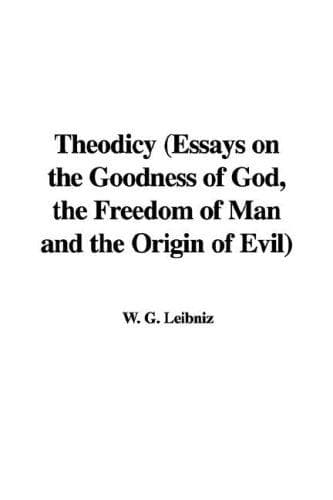
Theodicy: Essays on the Goodness of God, the Freedom of Man and the Origin of EvilLeibniz, Gottfried Wilhelm, Freiherr von
Religion
Theodicy: Essays on the Goodness of God, the Freedom of Man and the Origin of Evil
Leibniz, Gottfried Wilhelm, Freiherr von
Free will and determinism; Theism; Theodicy
more faith in his word than in that of many others.
37. Since it is permitted here to imagine possible cases, may one not
suppose this incomparable man to be the Adept or the Possessor of
_'that blessed Stone_
_Able to enrich all earthly Kings alone'_
and that he spends every day prodigious sums in order to feed and to rescue
from distress countless numbers of poor men? Be there never so many
witnesses or appearances of every kind tending to prove that this great
benefactor of the human race has just committed some larceny, is it not
true that the whole earth would make mock of the accusation, however
specious it might be? Now God is infinitely above the goodness and the
power of this man, and consequently there are no reasons at all, however
apparent they be, that can hold good against faith, that is, against the
assurance or the confidence in God wherewith we can and ought to say that
God has done all things well. The objections are therefore not insoluble.
They only involve prejudices and probabilities, which are, however,
overthrown by reasons incomparably stronger. One must not say either that
what we call _justice_ is nothing in relation to God, that he is the
absolute Master of all things even to the point of being able to condemn
the innocent without violating his justice, or finally that justice is
something arbitrary where he is concerned. Those are rash and dangerous
expressions, whereunto some have been led astray to the discredit of the
attributes of God. For if such were the case there would be no reason for
praising his goodness and his justice: rather would it be as if the most
wicked spirit, the Prince of evil genii, the evil principle of the
Manichaeans, were the sole master of the universe, just as I observed
before. What means would there be of distinguishing the true God from the
false God of Zoroaster if all things depended upon the caprice of an
arbitrary power and there were neither rule nor consideration for anything
whatever?
Public-domain text, read in full here on John Shaqi.
Reviews
Reviews
No reviews yet
Be the first to share your thoughts on this work.
Elsewhere in the archive
Join the Discussion
Join the discussion
Sign in to leave a comment or review.
Sign InorCreate an account