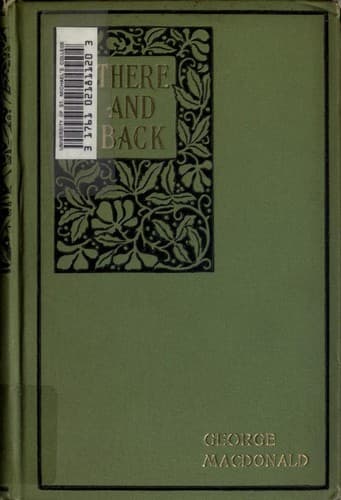
Christian fiction; Wingfold, Thomas (Fictitious character) -- Fiction
“If a man believed in a God that did not heed the suffering of the
creation, one who made men and women and beasts knowing that they must
suffer, and suffer only--and went on believing so however you set him
thinking about it, I should say to him, 'You believe in a devil, and
so are in the way to become a devil yourself.' A thousand times rather
would I believe that there was no God, and that the misery came by
chance from which there was no escape. What I do believe is, that there
is a God who is even now doing his best to take all men and all beasts
out of the misery in which they find themselves.”
“But why did he let them come into it?”
“That the God will tell them, to their satisfaction, so soon as ever
they shall have become capable of understanding it. There must be things
so entirely beyond our capacity, that we cannot now see enough of them
to be able even to say that they are incomprehensible. There must be
millions of truths that have not yet risen above the horizon of what we
call the finite.”
“Then you would not think a person so very, very wicked, for not
believing in a God?”
“That depends on the sort of God he fancied himself asked to believe in.
Would you call a Greek philosopher wicked for not believing in Mercury
or Venus? If a man had the same notion of God that I have, or anything
like it, and did not at least desire that there might be such a God,
then I confess I should have difficulty in understanding how he could
be good. But the God offered him might not be worth believing in, might
even be such that it was a virtuous act to refuse to believe in him.”
“One thing more, Mr. Wingfold--and you must not think I am arguing
against you or against God, for if I thought there was no God, I should
just take poison:--tell me, mightn't a man think the idea of such a God
as you believe in, too good to be true?”
“I should need to know something of his history, rightly to understand
that. Why should he be able to think anything too good to be true? Why
should a thing not be true because it was good? It seems to me, if a
thing be bad, it cannot possibly be true. If you say the thing is, I
answer it exists because of something under the badness. Badness by
itself can have no life in it. But if the man really thought as you
suggest, I would say to him, 'You cannot _know_ such a being does not
exist: is it possible you should be content that such a being should
not exist? If such a being did exist, would you be content never to find
him, but to go on for ever and ever saying, _He can't be! He can't be!
He's so good he can't be!_ Supposing you find one day that there he is,
will your defence before him be satisfactory to yourself: “There he is
after all, but he was too good to believe in, therefore I did not try
to find him”? Will you say to him--“_If you had not been so good, if you
had been a little less good, a little worse, just a trifle bad, I could
and would have believed in you?”_'”
Public-domain text, read in full here on John Shaqi.
Reviews
Reviews
No reviews yet
Be the first to share your thoughts on this work.
Elsewhere in the archive
Join the Discussion
Join the discussion
Sign in to leave a comment or review.
Sign InorCreate an account