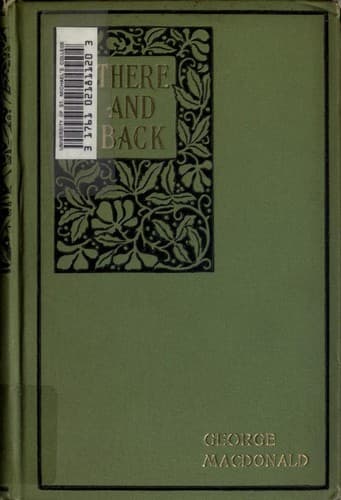
Christian fiction; Wingfold, Thomas (Fictitious character) -- Fiction
I can well imagine her coming to reason thus. For the present,
unnecessary as she was determined to think it, she yet resolved to do
all that was left her to do: she would watch; and while she watched,
would take care that the young man was subjected to no annoyance, lest
in his wrath his countenance should suggest to another, as to herself,
the question of his origin!
Thus it came that Richard heard nothing more of his threatened expulsion
from Mortgrange.
CHAPTER XXXIV. _BARBARA'S DUTY_.
The same afternoon appeared Barbara--as none knew when she might not
appear--before the front windows of the house, perched upon her huge yet
gracious Miss Brown. Arthur was in general upon the outlook for her, but
to-day he was not, being more vexed with her than usual for withholding
the encouragement he desired, and indeed imagined he deserved--not
exactly from vanity, yet no less from an overweening sense of his own
worth.
It is an odd delusion to which young men are subject, that, because they
admire, perhaps even love a woman, they have a claim on her love. Arthur
was confident that he loved Barbara as never man had loved, as never
woman had desired to be loved, and counted it not merely unjust but
cruel of her to show him no kindness that savoured of like attraction.
He did not know or suspect that a fortnight of the London season would
go far to make him forget her. He was not a bad sort of fellow, had no
vice, was neither snob nor cad; his worst fault was pride in himself
because of his family--pride in everything he had been born to, and in a
good deal he fancied he had been born to, in which his having was small
enough. He was not jealous of Barbara's pleasure in Richard's company.
The slightest probe of such a feeling toward a man so infinitely beneath
him, he would have felt degrading. To think of the two together would
have been to insult both Barbara and himself; to think of himself and
the bookbinder for one briefest moment of comparison, would have been to
insult all the Lestranges that ever lived. Tuke had no _raison d'être_
but work for the library that would one day be Arthur's, and by its
excellence add to the honour of Mortgrange! He forgot that Richard had
opened his eyes to its merit, and imagined himself the discoverer of its
value: did he not pay the man for his work? and is not what a man pays
for his own? Does not the purchaser of a patent purchase also the credit
of the invention? That the workman in the library knew as much more than
he about the insides as about the outsides of the books, gave him no
dignity in his eyes: none but a university-man at least must gain honour
by knowledge! The fact, however, did make him more friendly; and after
he got used to Richard he seldom stiffened his jelly to remind him that
their intercourse was by the sufferance of a humane spirit. Barbara's
behaviour to him had done nothing to humble him; for humiliation is at
best but a poisoned and poisonous humility.
Public-domain text, read in full here on John Shaqi.
Reviews
Reviews
No reviews yet
Be the first to share your thoughts on this work.
Elsewhere in the archive
Join the Discussion
Join the discussion
Sign in to leave a comment or review.
Sign InorCreate an account