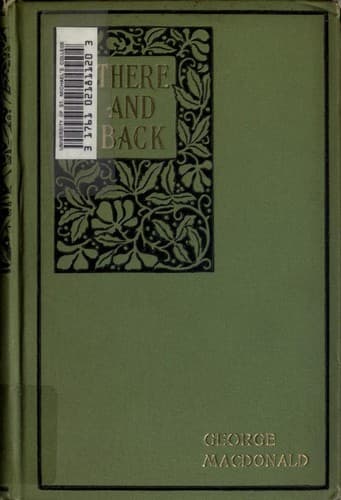
Christian fiction; Wingfold, Thomas (Fictitious character) -- Fiction
could it bring but the more condemnation, that a man should be sure
there was a God, if he did not cry to him? But although a man may
never doubt and never cry, I cannot imagine any man sure there is a God
without his first having cried to him. God is God to us not that we may
say _he is_, but _that we may know him_; and when we know him, then we
are with him, at home, at the heart of the universe, the heirs of all
things. All this is foolishness, I know, to the dull soul that cares
only for the things that admit of being proved. The unprovable mystery
out of which come the things provable, has for them no interest, they
say, because it is unprovable: they take for granted that therefore it
is unknowable. Would they be content it should be unknowable if things
were all as they should be within them? When the eyes of those who have
made themselves at home in the world of the senses and care for no other
are opened, I imagine them saying--'Yes, He was after all; but none the
less were you fools to believe in him, for you had no proof!' Then I
seem to hear the children laugh and say, 'We had himself, and did not
want it.' That the unprovable is necessarily the unknowable, a thousand
beliefs deny. 'You cannot prove to me that you have a father!' says the
blind sage, reasoning with the little child. 'Why should I prove it?'
answers the child. 'I am sitting on his knee! If I could prove it, that
would not make you see him; that would not make you happy like me! You
do not care about my father, or you would not stand there disputing; you
would feel about until you found him!' If a thing be true in itself, it
is not capable of proof; and that man is in the higher condition who
is able to believe it. In proportion as a man is a fool he is unable to
believe what in itself is true. If intellect be the highest power,
then the men of proof are the wisest; if there be something deeper than
intellect, causing and including it, if there be a creative power of
which our intellect is but a faint reflex, then the child of that power,
the one who acknowledges and loves and obeys that power, will be the
one to understand it. If a man say, 'I cannot believe; I was not made to
believe what I could not prove;' I reply, Do you really say, 'It is not
true,' because you have no proof? Ask yourself whether you do not turn
from the idea because you prefer it should not be true. You accept a
thousand things without proof, and a thousand things may be perfectly
true, and have no proof. But if you cannot be sure, why therefore do
you turn away? Is the thing assuredly false? Then you ought of course
to turn away. Can you prove it false? You cannot. Again, why do you turn
away? That a thing is not assuredly true, cannot be reason for turning
from it, else farewell to all theory and all scientific research! Is the
thing less good, less desirable, less worth believing, in itself, that
you cannot thus satisfy yourself concerning it? The very chance that
Public-domain text, read in full here on John Shaqi.
Reviews
Reviews
No reviews yet
Be the first to share your thoughts on this work.
Elsewhere in the archive
Join the Discussion
Join the discussion
Sign in to leave a comment or review.
Sign InorCreate an account