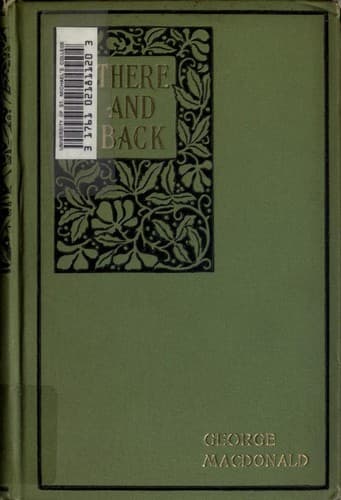
Christian fiction; Wingfold, Thomas (Fictitious character) -- Fiction
“I will,” replied Barbara.
The next morning she got on Miss Brown, and rode to the forge, where
Simon made her always welcome. It was sunshine to his heart to see her,
he said. She knew that Richard was to be there. They left Miss Brown
in the smithy, and went for a walk together, during which Barbara was
careful to follow the parson's advice. Their talk was mostly about her
life in New Zealand. Now that she knew God more, and believed more in
him, she was more able to set forth her history. Feelings long vague had
begun to put on shapes definite and communicable. She understood herself
better, and was better able to make Richard understand her. And in
Richard, by degrees, through the sympathy of affection, was growing the
notion of a God in whom it would not be hard to believe. He ought not
to believe, and he had not believed in the supposed being hitherto
presented to him as God; now he saw the shape of a God in whom, if he
existed, he ought to believe. But he had not yet come to long that he
should exist, to desire him, or to cry out in the hope that he would
hear him. His hour was not yet come. But when the day of darkness
arrived, when he knew himself helpless, there would be in his mind
a picture of the God to whom he must cry in his trouble--a God whose
existence would then be his only need, the one desire of his soul. To
wake the sense of this eternal need, present though unrecognized under
every joy, was the final cause of every sorrow and pain against which
Richard rebelled--most naturally rebelled, knowing neither the plague
of a heart that would but could not be lord over itself, nor of a nature
hatefully imperfect and spotted, yea capable of what itself could not
but detest.
Naturally, his manners were growing more refined from his intercourse
with the gracious, brave, sympathetic, unconventional creature, so
strong yet so gentle, so capable of indignation, so full of love. He
was gradually developing the pure humanity that lay beneath the rough
artisan. He was, in a word, becoming what in the kingdom of heaven every
man must be--a gentleman, because more than a gentleman.
All this time Barbara was pulled two ways: for Richard's sake she would
have him heir to the baronetcy; for her own she would be rid of the
shadow of having sought the baronet in the bookbinder. But more and more
the asseveration of lady Ann gained force with her--that Richard was not
the heir. She had greatly doubted her, but now she said to herself: “She
could hardly be mistaken, and she _cannot_ have lied.” The consequence
was that she grew yet more free, more at home with Richard. She
listened to all he had to tell her, learning of him with an _abandon_ of
willingness that put him upon his honour to learn of her again. And he
did learn, as I have said, a good deal--went farther than he knew in the
way of true learning.
Public-domain text, read in full here on John Shaqi.
Reviews
Reviews
No reviews yet
Be the first to share your thoughts on this work.
Elsewhere in the archive
Join the Discussion
Join the discussion
Sign in to leave a comment or review.
Sign InorCreate an account