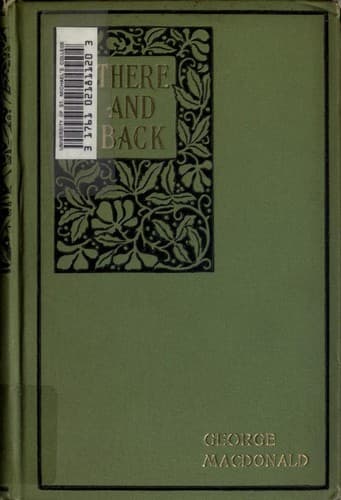
Christian fiction; Wingfold, Thomas (Fictitious character) -- Fiction
Barbara was happy all day long. Life seemed about to blossom into a
great flower of scarlet and gold. She had learned from the parson that
the bookbinder was gone, but was at the time too busy and too anxious to
question him as to the cause of his going. Till her mother was well, it
was enough to know that Richard had wanted to see her, doubtless to tell
her all about it. She often thought of him, what he had done for her,
and what she had tried to do for him, and was certain he would one
day believe in God. She did not suspect any quarrel with the people at
Mortgrange. She thought perhaps the secret concerning him had come out,
and he did not choose to remain in a house the head of which, if lady
Ann's tale was true, had so bitterly wronged his mother. As soon as she
was able she would go and hear of him from his grandfather! There was
no hurry! She would certainly see him again before long! And he would be
sure to write! It did not occur to her that a man in his position would
hardly venture to approach her again, without some renewed approach on
her part; and for a long time she was nowise uneasy.
The hope alive in Wingfold made him a true consoler; and the very
sight of him was a strength to Barbara. She regarded him with profound
reverence, and his wife as most enviable of women: could she not learn
from his mouth the rights of a thing, the instant she opened hers to ask
them? Barbara did not know how much the sympathy, directness, and dear
common sense of Helen, had helped to keep awake, support, and nourish
the insight of her husband. She did not know, good and powerful as
Wingfold must have been had he never married, how much wiser, more
useful, and more aspiring he had grown because Helen was Helen, and his
wife, sent as certainly as ever angel in the old time. The one fault
she had in the eyes of her husband was, that she was so indignant with
affectation or humbug of any sort, as hardly to give the better thing
that might coexist with it, the needful chance.
So long as evil comes to the front, it appears an interminable,
unconquerable thing. But all the time there may be a change, positive
as inexplicable, at the very door. How is it that a child begins to
be good? Upon what fulcrum rests the knife-edge of alteration? As
undistinguishable is the moment in which the turn takes place; equally
perplexing to keenest investigation the part of the being in which the
renovation commences. Who shall analyze repentance, as a force, or as a
phenomenon! You cannot see it coming! Before you know, there it is, and
the man is no more what he was; his life is upon other lines! The wind
hath blown. We saw not whence it came, or whither it went, but the
new birth is there. It began in the spiritual infinitesimal, where all
beginnings are. The change was begun in Mrs. Wylder. But the tug of her
war was to come.
Public-domain text, read in full here on John Shaqi.
Reviews
Reviews
No reviews yet
Be the first to share your thoughts on this work.
Elsewhere in the archive
Join the Discussion
Join the discussion
Sign in to leave a comment or review.
Sign InorCreate an account