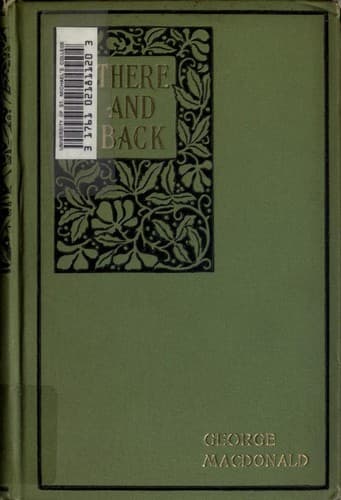
Christian fiction; Wingfold, Thomas (Fictitious character) -- Fiction
It was into the first of the London fogs of the season that Richard,
after a slow parliamentary journey, got out of his third-class carriage,
at the great dim station. He took his portmanteau in one hand, and his
bag of tools in the other, and went to look for an omnibus. How terribly
dull the streets were! and how terribly dull and commonplace all inside
him! Into the far dark, the splendour of life, Barbara, had vanished!
Various memories of her, now this look, now that, now this attire, now
that--a certain button half torn from her riding habit--the feeling of
her foot in his hand as he lifted her to Miss Brown's back--would enter
his heart like the proclamation of a queen on a progress through her
dominions. The way she drove the nails into her mare's hoof; the way
she would put her hand on his shoulder as she slid from the saddle; the
commanding love with which she spoke to the great animal, and the
way Miss Brown received it; the sweet coaxing respect she showed his
blacksmith-grandfather; the tone of her voice when she said _God_;--a
thousand attendant shadows glided in her queen-procession, one after the
other in single file, through his brain, and his heart, and his every
power. He forgot the omnibus, and went tramping through the dreary
streets with his portmanteau and a small bag of tools--he had sent home
his heavier things before--thinking ever of Barbara, and not scorning
himself for thinking of her, for he thought of her as true lady herself
would never scorn to be thought of by honest man. No genuine unselfish
feeling is to be despised either by its subject or its object. That
Barbara was lovely, was no reason why Richard should not love her! that
she was rich, was no reason why he should forget her! She came into his
life as a star ascends above the horizon of the world: the world cannot
say to it, “Go down, star.” Yea, Richard's star raised him as she rose.
In her presence he was at once rebuked and uplifted. She was a power
within him. He could not believe in God, but neither could he think
belief in such a God as she believed in, degrading. He said to himself
that everything depended on the kind of God believed in; and that the
kind of God depended on the kind of woman. He wondered how many ideas
of God there might be, for every one who believed in him must have a
different idea. “Some of them must be nearer right than others!” he said
to himself--nor perceived that he was beginning to entertain the notion
of a real God. For he saw that the notions of the best men and women
must be convergent, and was not far from thinking that such lines must
point to some object, rather than an empty centre: the idea of the best
men and women must be a believable idea, might be a true idea, might
therefore be a real existence. He had not yet come to consider the fact,
that the best of men said he knew God; that God was like himself, only
greater; that whoever would do what he told him should know that God,
Public-domain text, read in full here on John Shaqi.
Reviews
Reviews
No reviews yet
Be the first to share your thoughts on this work.
Elsewhere in the archive
Join the Discussion
Join the discussion
Sign in to leave a comment or review.
Sign InorCreate an account