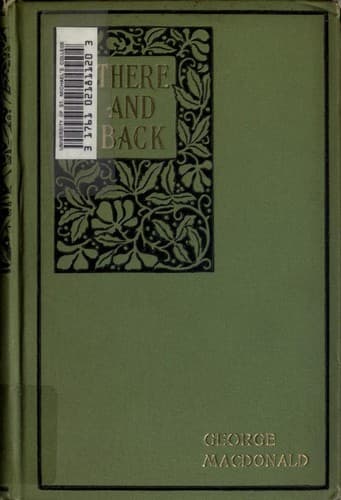
Christian fiction; Wingfold, Thomas (Fictitious character) -- Fiction
He began to wonder whether even an all-mighty and all-good God would be
able to contrive such a world as no somebody in it would ever complain
of. What if he had plans too large for the vision of men to take in, and
they were uncomfortable to their own blame, because, not seeing them,
they would trust him for nothing? He knew unworthy men full of complaint
against an economy that would not let them live like demons, and be
blessed as seraphs! Why should not a man at least wait and see what
the possible being was about to do with him, perhaps for him, before he
accused or denied him? At worst he would be no worse for the waiting!
His thinking was stopped by a sudden flood of self-contempt. Was Barbara
to live alone that he might think of her in peace! He was a selfish,
disgraceful, degraded animal, deserving all he suffered, and ten times
more! What did it matter whether _he_ was happy or not, if it was well
with her! Was he a man, and could he not endure! Here was a possible
nobility! here a whole world wherein to be divine! A man was free to
sacrifice his happiness: for him, he had nothing but his crowned sorrow;
he would sacrifice that! Had anyone ever sacrificed his sorrow to his
love? Would it not be a new and strange sacrifice? To know that he
suffered would make her a little unhappy: for her sake he would _not_ be
unhappy! He would at least for her sake fight with his grief; he would
live to love her still, if never more to look on her face. In after
eternal years, if ever once more they met, he would tell her how for her
sake he had lived in peace, and neither died nor gone mad! Yea, for her
sake, he would still seek her God, if haply he might find him! Was there
not a possible hope that he would justify to him, even in his heart,
his ways with men, and his ways with himself among his fellows? What if
there was a way so much higher than ours, as to include all the seeming
right and seeming wrong in one radiance of righteousness! The idea was
scarce conceivable; it was not one he could illustrate to himself; but,
as a thought transcending flesh and blood, better and truer than what
_we_ are able to think of as truth, he would try to hold by it! Things
that we are right in thinking bad, must be bad to God as well as to us;
but may there not be things so far above us, that we cannot take them
in, and they seem bad because they are so far above us in goodness that
we see them partially and untruly? There must be room in his wisdom
for us to mistake! He would try to trust! He would say, “If thou art my
father, be my father, and comfort thy child. Perhaps thou hast some way!
Perhaps things are not as thou wouldst have them, and thou art doing
what can be done to set them right! If thou art indeed true to thy own,
it were hard not to be believed--hard that one of thine own should
not trust thee, should not give thee time to make things clear, should
behave to thee as if thou wouldst not explain, when it is that we are
unable to understand!”
Public-domain text, read in full here on John Shaqi.
Reviews
Reviews
No reviews yet
Be the first to share your thoughts on this work.
Elsewhere in the archive
Join the Discussion
Join the discussion
Sign in to leave a comment or review.
Sign InorCreate an account