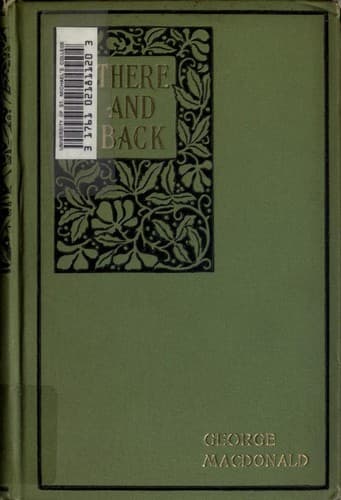
Christian fiction; Wingfold, Thomas (Fictitious character) -- Fiction
Partly from her anxiety about what she had done and what she had yet to
do, the show of her love had, as the boy grew up, gradually retired; her
love burned more, and shone less. If Jane Tuke had been able to let her
love appear in such forms as suited its strength, I doubt whether the
teaching of his father would have had much power upon Richard; certainly
he would have been otherwise impressed by the faith of his mother. He
would have been prejudiced in favour of the God she believed in, and
would have sought hard to account for the ways attributed to him. None
the less would it have been through much denial and much suffering that
he arrived at anything worth calling faith; while the danger would have
been great of his drifting about in such indifference as does not care
that God should be righteous, and is ready to call anything just which
men in office declare God does, without concern whether it be right or
wrong, or whether he really does it or not--without concern indeed about
anything at all that is God's. He would have had phantoms innumerable
against him. He would have supposed the Bible said things about God
which it does not say, things which, if it did say them, ought to be
enough to make any honest man reject the notion of its authority as an
indivisible whole. He would have had to encounter all the wrong notions
of God, dropped on the highway of the universe, by the nations that went
before in the march of humanity. He would have found it much harder to
work out his salvation, to force his freedom from the false forms given
to truth by interpreters of little faith, for they would have seemed
born in him because loved into him.
“What did you say, mother dear?” he returned, all astray, seeming to
have once known several things, but now to know nothing at all.
“It is under your pillow, Richard,” she said again, very tenderly.
“What is it, mother? Something seems strange. I don't know what to ask
you. Tell me what it means.”
“You have been very ill, my boy; that is what it means.”
“Have I been out of my mind?”
“You have been wandering with the fever, nothing more.”
“I have been thinking so many things, and they all seemed real!--And you
have been nursing me all the long time?”
“Who should have been nursing you, Richard? Do you think I would let any
one else nurse my own child? Didn't I nurse the--”
She stopped; she had been on the point of saying--“the mother that bore
you?” Her love of her dead sister was one with her love of that sister's
living child.
He lay silent for a time, thinking, or rather trying to think, for he
felt like one vainly endeavouring to get the focus of a stereoscopic
picture. His mind kept going away from him. He knew himself able
to think, yet he could not think. It was a revelation to him of our
helplessness with our own being, of our absolute ignorance of the modes
in which our nature works--of what it is, and what we can and cannot do
with it.
“Shall I get it for you, dear?” said his mother.
Public-domain text, read in full here on John Shaqi.
Reviews
Reviews
No reviews yet
Be the first to share your thoughts on this work.
Elsewhere in the archive
Join the Discussion
Join the discussion
Sign in to leave a comment or review.
Sign InorCreate an account