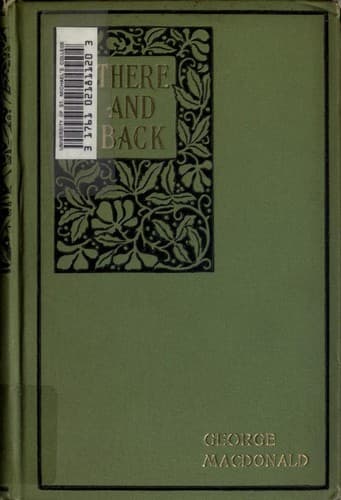
Christian fiction; Wingfold, Thomas (Fictitious character) -- Fiction
Where husband and wife are not one, it is impossible for the daughter to
be one with both, or perhaps with either; and the constant and foolish
bickering to which Barbara had been a witness throughout her childhood,
had tended rather to poison than nourish respect. Whether Barbara failed
to yield as much as Mr. Wylder had a right to claim, I leave to the
judgment of my reader, reserving my own, and remarking only that, if
his judgment be founded on principles differing from mine, our judgments
cannot agree. The idea of parent must be venerated, and may cast a glow
upon the actual parent, himself nowise venerable, so that the heart of a
daughter may ache with the longing to see her father such that she could
love and worship him as she would; but when it comes to life and action,
the will of such a parent, if it diverge from what seems to the child
true and right, ought to weigh nothing. A parent is not a maker, is not
God. We must leave father and mother and all for God, that is, for what
is right, which is his very will--only let us be sure it is for God,
and not for self. If the parent has been the parent of good thoughts and
right judgments in the child, those good thoughts and right judgments
will be on the parent's side: if he has been the parent of evil thoughts
and false judgments, they may be for him or against him, but in the end
they will work solely for division. Any general decay of filial manners
must originate with the parents.
“I am not a child. I am a woman,” said Barbara; “and I owe it to him who
made me a woman, to take care of her.”
“Mind what you say. I have rights, and will enforce them.”
“Over my person?” returned Barbara, her eyes sending out a flash that
reminded him of her mother, and made him the angrier.
“If you do not consent here and now,” he said sternly, “to marry Mr.
Lestrange--that is, if, after your mother's insolence to lady Ann.--”
“My mother's insolence to lady Ann!” exclaimed Barbara, drawing herself,
in her indignation, to the height of her small person: but her father
would rush to his own discomfiture.
“--if, as I say,” he went on, “he should now condescend to ask you--I
swear--”
“You had better not swear, papa!”
“--I swear you shall not have a foot of my land.”
“Oh! that is all? There you are in your right, and I have nothing to
say.”
“You insolent hussy! You won't like it when you find it done!”
“It will be the same as if Mark had lived.”
“It's that cursed money of your mother's makes you impudent!”
“If you could leave me moneyless, papa, it would make no difference. A
woman that can shoe her own horse,--”
“Shoe her own horse!” cried her father.
“Yes, papa!--You couldn't!--And I _made_ two of her shoes the last time!
Wouldn't any woman that can do that, wouldn't she--to save herself from
shame and disgust--to be queen over herself--wouldn't she take a place
as house-maid or shop-girl rather than marry the man she didn't love?”
Mr. Wylder saw he had gone too far.
Public-domain text, read in full here on John Shaqi.
Reviews
Reviews
No reviews yet
Be the first to share your thoughts on this work.
Elsewhere in the archive
Join the Discussion
Join the discussion
Sign in to leave a comment or review.
Sign InorCreate an account