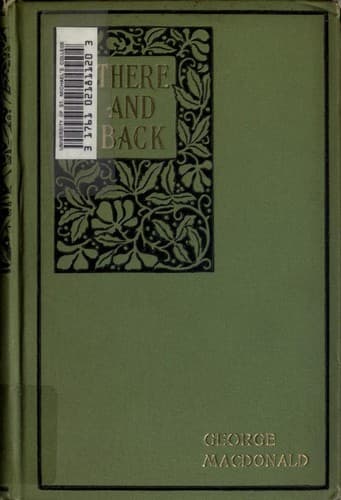
Christian fiction; Wingfold, Thomas (Fictitious character) -- Fiction
With his help she was now studying, to no little advantage, more than
one subject connected with the main interest common to her and Richard:
and she thought constantly of what Richard would say, and how she would
answer him. Hence, naturally, she had the more questions to put to her
tutor. Now Wingfold had passed through all Richard's phases, and through
some that were only now beginning to show in him; therefore he was well
prepared to help her--although there was this difference between the
early moral conditions of the two men, that Wingfold had been prejudiced
in favour of much that he found it impossible to hold, whereas Richard
had been prejudiced against much that ought to be cast away.
Richard suffered not a little at times from his enforced silence:
what might not happen because he must not speak? But hearing nothing
discouraging from his grandfather, he comforted himself in hope. He knew
that in him he had a strong ally, and that Barbara loved the hot-hearted
blacksmith, recognizing in him a more genuine breeding, as well as a far
greater capacity, than in either sir Wilton or her father. He toiled on
doing his duty, and receiving in himself the reward of the same, with
further reward ever at the door. For there is no juster law than the
word, “To him that hath shall be given.”
“Why do I never see you on Miss Brown?” asked Wingfold one day of
Barbara.
“For a reason I think I ought not to tell you.”
“Then don't tell me,” returned the parson.
But by a mixture of instinctive induction, and involuntary intuition, he
saw into the piece of domestic tyranny, and did what he could to make up
for it, by taking her every now and then a long walk or drive with
his wife and their little boy. He gave her strong hopeful things to
read--and in the search after such was driven to remark how little of
the hopeful there is in the English, or in any other language. The song
of hope is indeed written in men's hearts, but few sing it. Yet it is of
all songs the sorest-needed of struggling men.
Heart and brain, Wingfold was full of both humour and pathos. In their
walks and drives, many a serious subject would give occasion to the
former, and many a merry one to the latter. Sometimes he would take
a nursery-rime for his theme, and expatiate upon it so, that at one
instant Barbara would burst into the gayest laughter, and the next
have to restrain her tears. Rarely would Wingfold enter a sick-chamber,
especially that of a cottage, with a long face and a sermon in his soul;
almost always he walked lightly in, with a cheerful look, and not seldom
an odd story on his tongue, well pleased when he could make the sufferer
laugh--better pleased sometimes when he had made him sorry. He did not
find those that laughed the readiest the hardest to make sorry. He moved
his people by infecting their hearts with the feeling in his own.
Public-domain text, read in full here on John Shaqi.
Reviews
Reviews
No reviews yet
Be the first to share your thoughts on this work.
Elsewhere in the archive
Join the Discussion
Join the discussion
Sign in to leave a comment or review.
Sign InorCreate an account