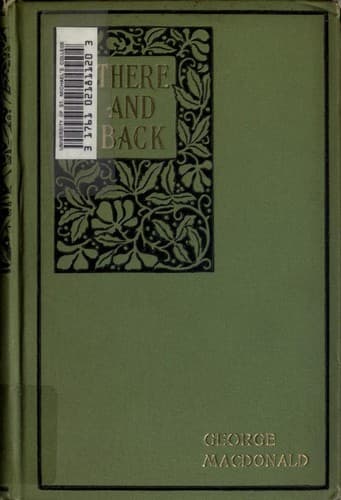
Christian fiction; Wingfold, Thomas (Fictitious character) -- Fiction
Wingfold suspected in the paper some provision for Richard, but could
imagine no reason for letting it lie unopened until a year should have
passed from the baronet's death. Troubling himself nothing, however,
about what was not his business, he put the paper carefully aside--but
where he must see it now and then, lest it should pass from his mind,
and with sir Wilton's permission, told his wife what he had undertaken
concerning it, that she might carry it out if he were prevented from
doing so.
Time went on. Communication grew yet less between Mr. Wylder and his
family. He had returned to certain old habits, and was spending money
pretty fast in London. Failing to make himself a god in the house, he
forsook it, and was rapidly losing this world's chance of appreciating a
woman whose faults were to his as new wine to dirty water.
In the fourth year, Richard wrote to his father, through his grandfather
of course, informing him he had got his B.A. degree, and was waiting
further orders. The baronet was heartily pleased with the style of his
letter, and in the privacy of his own room gave way to his delight at
the thought of his wife's approaching consternation and chagrin. At
the same time, however, he was not a little uneasy in prospect of the
denouement. For the eyes of his wife had become almost a terror to him.
Their grey ice, which had not grown clearer as it grew older, made
him shiver. Why should the stronger so often be afraid of the weaker?
Sometimes, I suppose, because conscience happens to side with the
weaker; sometimes only because the weaker is yet able to make the
stronger, especially if he be lazy and a lover of what he calls peace,
worse than uncomfortable. The baronet dared not present his son to
his wife except in the presence of at least one stranger. He wrote to
Richard, appointing a day for his appearance at Mortgrange.
CHAPTER LVIII. _THE HEIR_.
It was a lovely morning when Richard, his heart beating with a hope
whose intensity of bliss he had never imagined, stopped at the station
nearest to Mortgrange, and set out to walk there in the afternoon sun.
June folded him in her loveliness of warmth and colour. The grass
was washed with transparent gold: he saw both the gold and the green
together, but unmingled. Often had he walked the same road, a contented
tradesman; a gentleman now, with a baronet to his father, he loved,
and knew he must always love the tradesman-uncle more than the
baronet-father. He was much more than grateful to his father for his
ready reception of him, and his care of his education; but he could
not be proud of him as of his mother and his aunt and uncle and his
grandfather. He held it one of God's greatest gifts to come of decent
people; and if in his case the decency was on one side only, it was the
more his part to stop the current of transmitted evil, and in his own
person do what he might to annihilate it!
Public-domain text, read in full here on John Shaqi.
Reviews
Reviews
No reviews yet
Be the first to share your thoughts on this work.
Elsewhere in the archive
Join the Discussion
Join the discussion
Sign in to leave a comment or review.
Sign InorCreate an account