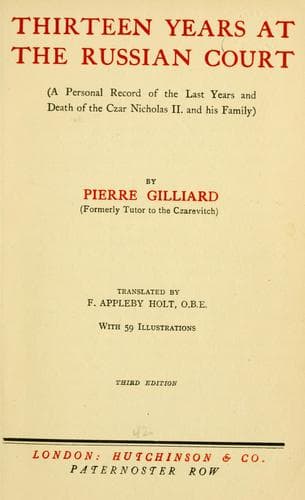
Thirteen years at the Russian court: (a personal record of the last years and death of the Czar Nicholas II. and his family)Gilliard, Pierre
History
Thirteen years at the Russian court: (a personal record of the last years and death of the Czar Nicholas II. and his family)
Gilliard, Pierre
Nicholas II, Emperor of Russia, 1868-1918; Romanov, House of; Soviet Union -- History -- Revolution, 1917-1921 -- Personal narratives
I worked for several days with M. Sokolof; then he left for Ekaterinburg
to continue the enquiry opened by Serguéief.
In April, General Ditériks, who was returning from Vladivostok--where he
had been sent by Admiral Koltchak on a special mission--came to join him
and assist his efforts. Thenceforward the enquiry made rapid progress.
Hundreds of persons were interrogated, and, as soon as the snow had
gone, work was begun on a large scale in the clearing in which the
Koptiaki peasants had found articles belonging to the Imperial family.
The mine-shaft was emptied and thoroughly examined. The ashes and soil
of part of the clearing were passed through sieves, and the whole of the
surrounding area carefully examined. They succeeded in determining the
site of two large fires and, more vaguely, the traces of a third. This
methodical research soon brought discoveries of extreme importance.
Devoting himself wholeheartedly to the work he had undertaken, and
displaying untiring patience and diligence, M. Sokolof was able in a few
months to reconstruct every circumstance of the crime with remarkable
accuracy.
CHAPTER XXII
THE CIRCUMSTANCES OF THE CRIME ESTABLISHED BY THE ENQUIRY
In the following pages I shall describe the circumstances of the murder
of the Imperial family as they appear from the depositions of the
witnesses and evidence examined by the enquiry. From the six thick
manuscript volumes in which it is contained I have extracted the
essential facts of this drama about which, alas! there can be no longer
any doubt. The impression left by reading these documents is that of a
ghastly nightmare, but I do not feel justified in dwelling on the
horror.
About the middle of May, 1918, Yankel Sverdlof, President of the Central
Executive Committee at Moscow, yielding to the pressure of Germany,[75]
sent Commissary Yakovlef to Tobolsk to arrange for the transfer of the
Imperial family. He had received orders to take them to Moscow or
Petrograd. In carrying out his mission he met with resistance which he
did his best to overcome, as the enquiry has established. This
resistance had been organised by the divisional government of the Ural,
whose headquarters were at Ekaterinburg. It was they who, unknown to
Yakovlef, prepared the trap which enabled them to seize the Emperor _en
route_. But it appears to have been established that this plan had been
secretly approved by Moscow. It is more than probable, indeed, that
Sverdlof was playing a double game, and that, while pretending to accede
to the pressure of General Baron von Mirbach in Moscow, he had arranged
with the Ekaterinburg commissaries not to let the Czar escape. However
this may be, the installation of the Czar at Ekaterinburg was carried
out on the spur of the moment. In two days the merchant Ipatief was
evicted from his house and the construction of a strong wooden fencing
rising to the level of the second-floor windows begun.
Public-domain text, read in full here on John Shaqi.
Reviews
Reviews
No reviews yet
Be the first to share your thoughts on this work.
Elsewhere in the archive
Join the Discussion
Join the discussion
Sign in to leave a comment or review.
Sign InorCreate an account