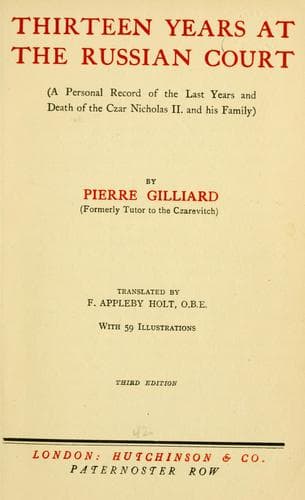
Thirteen years at the Russian court: (a personal record of the last years and death of the Czar Nicholas II. and his family)Gilliard, Pierre
History
Thirteen years at the Russian court: (a personal record of the last years and death of the Czar Nicholas II. and his family)
Gilliard, Pierre
Nicholas II, Emperor of Russia, 1868-1918; Romanov, House of; Soviet Union -- History -- Revolution, 1917-1921 -- Personal narratives
Alexis Nicolaïevitch’s ill-health had been aggravated by the fatigue of
the journey; he spent the greater part of the day lying down, and when
they went out to take the air it was the Czar who carried him as far as
the garden.
The family and servants took their meals with the commissaries, who
occupied the same floor as themselves, and so lived in constant
proximity with these coarse men, who more often than not were drunk.
The house had been surrounded by a second fence of boards; it had been
turned into a veritable prison fortress. There were sentries stationed
outside and within, machineguns in the building and garden. The room of
the Commissary Commandant--the first on entering the house--was occupied
by Commissary Avdief, his adjutant Mochkine, and some workmen. The rest
of the guard lived in the basement, but the men often came upstairs and
strolled into the rooms of the Imperial family as they liked. The
courage of the prisoners was, however, sustained in a remarkable way by
religion. They had kept that wonderful faith which at Tobolsk had been
the admiration of their _entourage_ and which had given them such
strength, such serenity in suffering. They were already almost entirely
detached from this world. The Czarina and Grand-Duchesses could often be
heard singing religious airs, which affected their guards in spite of
themselves.
Gradually these guards were humanised by contact with their prisoners.
They were astonished at their simplicity, attracted by their gentleness,
subdued by their serene dignity, and soon found themselves dominated by
those whom they thought they held in their power. The drunken Avdief
found himself disarmed by such greatness of soul; he grew conscious of
his own infamy. The early ferocity of these men was succeeded by
profound pity.
The Soviet authorities in Ekaterinburg comprised:
(a) _The Divisional Council of the Urals_, consisting of about thirty
members under the presidency of Commissary Bieloborodof.
(b) _The Presidium_, a sort of executive committee of several members:
Bieloborodof, Golochtchokine, Syromolotof, Safarof, Voïkof, etc.
(c) _The Tchrezvytchaïka._ The popular title of the “Extraordinary
Commission for Combating Counter-Revolution and Speculation,” with its
centre at Moscow and branches throughout Russia. This is a formidable
organisation which is the very foundation of the Soviet régime. Each
section receives its orders direct from Moscow and carries them out
through its own resources. Every _Tchrezvytchaïka_ of any importance
commands the services of a band of nondescript agents, generally
Austro-German prisoners of war, Letts, Chinese, etc., who are in reality
nothing more than highly-paid executioners.
In Ekaterinburg the _Tchrezvytchaïka_ was all-powerful. Its most
influential members were Commissaries Yourovsky, Golochtchokine, etc.
* * * * *
Public-domain text, read in full here on John Shaqi.
Reviews
Reviews
No reviews yet
Be the first to share your thoughts on this work.
Elsewhere in the archive
Join the Discussion
Join the discussion
Sign in to leave a comment or review.
Sign InorCreate an account