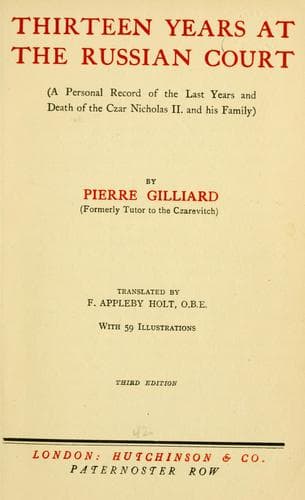
Thirteen years at the Russian court: (a personal record of the last years and death of the Czar Nicholas II. and his family)Gilliard, Pierre
History
Thirteen years at the Russian court: (a personal record of the last years and death of the Czar Nicholas II. and his family)
Gilliard, Pierre
Nicholas II, Emperor of Russia, 1868-1918; Romanov, House of; Soviet Union -- History -- Revolution, 1917-1921 -- Personal narratives
As we were coming back from our usual drive this morning, so dense
was the crowd that the chauffeur was obliged to stop in one of the
rather narrow streets in the Yakimanskaïa quarter. The crowd
consisted of humble folk and peasants from the district who had
come into the city to shop or in the hope of seeing the Czar. All
at once there was a loud shout: “The Heir!... The Heir!...” The
crowd surged towards us, surrounded us, and came up so close that
our way was blocked, and we, so to speak, found ourselves prisoners
of these _moujiks_, workmen and shopkeepers who struggled and
fought, shouted, gesticulated, and behaved like lunatics in order
to get a better view of the Czarevitch. By degrees some of the
women and children grew bolder, mounted the steps of the car,
thrust their arms over the doors, and when they succeeded in
touching the boy they yelled out triumphantly: “I’ve touched
him!... I’ve touched the Heir!...”
Alexis Nicolaïevitch, frightened at these exuberant demonstrations,
was sitting far back in the car. He was very pale, startled by this
sudden popular manifestation, which was taking extravagant forms
which were quite novel to him. He recovered himself, however, when
he saw the kindly smiles of the crowd, but he remained embarrassed
at the attention bestowed upon him, not knowing what to say or do.
Personally, I was speculating, not without considerable anxiety,
how all this would end, for I knew that no police regulations are
issued for the Czarevitch’s drives as neither the time nor the
route can be fixed beforehand. I began to fear that we might meet
with some accident in the middle of this unruly crowd swarming
round us.
To my relief two huge _gorodovy_ (policemen) came up, puffing and
blowing, shouting and storming. The crowd displayed the
unquestioning and resigned obedience of the _moujik_. It began to
waver, then slowly drifted away. I then told Derevenko, who was
following in another car, to go ahead, and by degrees we succeeded
in getting clear.
_Friday, August 21st._--Their Majesties, before returning to
Tsarskoïe-Selo, decided to visit the Troïtsa Monastery, the most
celebrated sanctuary in Russia after the world-famed _Laure_ of
Kiev. The train took us as far as the little station of Serghievo,
from which we reached the monastery by car. Perched on a hill, it
would be taken for a fortified city from a distance if the
bright-coloured towers and gilded domes of its thirteen churches
did not betray its true purpose. In the course of its history this
rampart of Orthodoxy has had to resist some formidable assaults,
the most famous being the sixteen months’ siege by an army of
thirty thousand Poles at the beginning of the seventeenth century.
Public-domain text, read in full here on John Shaqi.
Reviews
Reviews
No reviews yet
Be the first to share your thoughts on this work.
Join the Discussion
Join the discussion
Sign in to leave a comment or review.
Sign InorCreate an account