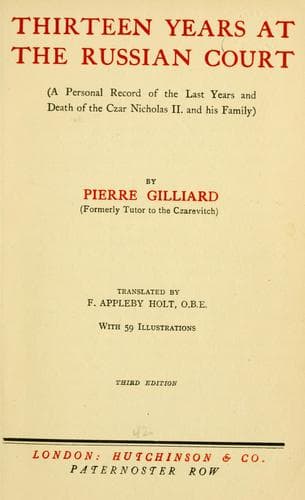
Thirteen years at the Russian court: (a personal record of the last years and death of the Czar Nicholas II. and his family)Gilliard, Pierre
History
Thirteen years at the Russian court: (a personal record of the last years and death of the Czar Nicholas II. and his family)
Gilliard, Pierre
Nicholas II, Emperor of Russia, 1868-1918; Romanov, House of; Soviet Union -- History -- Revolution, 1917-1921 -- Personal narratives
This monastery, like Moscow and the towns of the Upper Volga, is a
spot where the past seems ever present. It calls up visions of the
Russia of the boyarin, the Grand-Dukes of Moscow, and the first
Czars, and vividly explains the historical evolution of the Russian
people.
The Imperial family were present at a _Te Deum_ and knelt before
the relics of St. Sergius, the founder of the monastery. The
Archimandrite then handed the Czar an icon painted in a fragment of
the coffin of the saint, one of the most revered in Russia. In
olden times this image always accompanied the Czars on their
campaigns. On the Czar’s orders it is being sent to General
Headquarters and placed in the “field chapel” of the
Commander-in-Chief of the Russian Armies.
The Czar, Czarina, and their children visited the little church of
Saint Nicon and then stayed a few minutes in the ancient residence
of the patriarchs. As time was pressing, we had to abandon the idea
of visiting the hermitage of Gethsemane, which is a little distance
from the monastery. In accordance with a practice still frequently
observed in Russia, certain hermits still have themselves shut up
here in subterranean walled cells. They live in prayer and fasting
to the end of their days, completely isolated from the world, and
the slit through which their food is passed is their sole means of
communication with their fellow-men.
The Imperial family bade the Archimandrite farewell and left the
monastery, accompanied by a crowd of monks who swarmed round the
cars.
CHAPTER X
THE FIRST SIX MONTHS OF THE WAR
On August 22nd we returned to Tsarskoïe-Selo, where the Czar was to be
obliged to spend some time before he could get away to General
Headquarters. Decisions of the utmost importance required his presence
near the capital.
Notwithstanding the terrible weight of responsibility on his shoulders,
the Czar never showed such firmness, resolution, and conscious energy as
during this period at the beginning of the war. His personal influence
had never been exerted with more authority. It seemed as if he had
devoted himself body and soul to the formidable task of leading Russia
to victory. We felt he was inspired by some inward force and a dour
determination to conquer which communicated itself to everyone with whom
he came in contact.
The Czar was shy and retiring by nature. He belonged to the category of
human beings who are always hesitating because they are too diffident
and are ever slow to impose their will on others because they are too
gentle and sensitive. He had little faith in himself and imagined that
he was one of the unlucky ones. Unfortunately his life seemed to show
that he was not entirely wrong. Hence his doubts and hesitations. But
this time it seemed as if he had changed. What was it gave him his
confidence?
Public-domain text, read in full here on John Shaqi.
Reviews
Reviews
No reviews yet
Be the first to share your thoughts on this work.
Join the Discussion
Join the discussion
Sign in to leave a comment or review.
Sign InorCreate an account